

What Is an AI Agent? A Plain-English Explainer for Non-Engineers
A thermostat does not need to ask permission every time it turns on the heat. It senses the temperature, decides what to do, and acts. That simple loop, sense, decide, act, is the oldest idea behind something now getting a much bigger name: the AI agent. The difference in 2026 is that the “sensing” involves reading your email, the “deciding” involves a language model reasoning through options, and the “acting” might mean booking a flight, filing a report, or negotiating with another piece of software entirely.
If you have heard the term tossed around in meetings or tech news and felt a little lost, this guide answers the actual question most non-engineers are asking: What is an AI agent, in plain English, and why does it matter to my work? We will walk through what makes an agent different from a chatbot, the levels of autonomy you will encounter, real examples from 2026, and the risks worth knowing about before you hand one a task.
Key Takeaways
- An AI agent is software that can perceive information, reason about it, take action, and often learn from the result, without a human approving every single step.
- Agentic AI goes beyond chatbots by adding memory, tool use, and the ability to complete multi-step tasks on its own.
- Autonomy exists on a spectrum, from simple helpers that draft text to near-independent systems that run continuously across apps.
- Real-world use has expanded fast in 2026, from retail shopping agents to enterprise “digital coworkers,” but governance and security have not caught up.
- Before relying on an agent for anything important, verify what it can actually do, what data it touches, and what happens when it gets something wrong.
What Is an AI Agent in Plain English
Strip away the jargon and an AI agent is a program built to pursue a goal rather than just answer a question. You give it an objective, “reconcile this spreadsheet,” “find me a flight under $400,” “monitor this inbox and flag urgent messages”, and it figures out the steps on its own. It can check a calendar, search the web, call another piece of software, review the result, and try again if something fails.
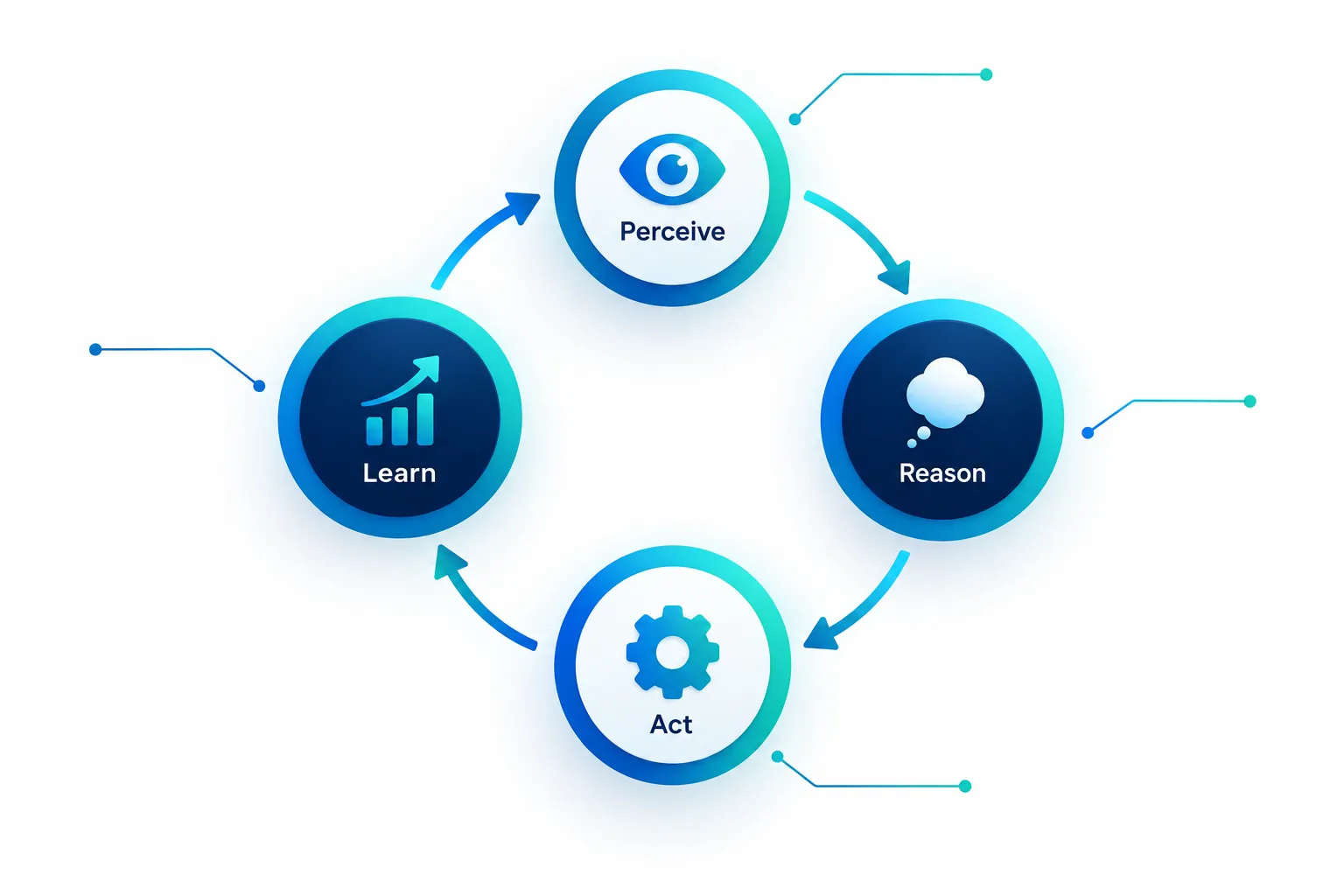
This is different from asking a search engine a question or typing a prompt into a chat window once. An agent keeps working across multiple steps, and it often keeps a kind of short-term memory of what it has already tried. Researchers describe this using a four-part cycle: perceive, reason, act, and learn. The agent perceives its environment (an inbox, a database, a webpage), reasons about what to do next using a language model, takes an action, and then updates its approach based on what happened. That cycle, formalized in academic work on agent architecture published in 2026, is the backbone of nearly every agent product on the market today.
For a closer look at how this compares to the chat-based tools most people already use, see What Is an AI Agent and How Is It Different from a Chatbot?
How Agentic AI Differs from a Basic Chatbot
A basic chatbot is reactive. You ask, it answers, the conversation ends unless you keep typing. An agent is proactive within the boundaries you set. The shift from chatbot to agent usually involves three additions:
- Tool use. The agent can call external tools, a calendar API, a search function, a spreadsheet, a code interpreter, rather than only generating text.
- Persistence. It can keep working on a task over minutes, hours, or in some 2026 products, continuously in the background, rather than stopping after one reply.
- Goal-directed planning. Instead of answering one question at a time, it breaks a goal into sub-steps and works through them in sequence, adjusting if a step fails.
This is the core distinction behind what the industry now calls “agentic AI”: software that acts on your behalf rather than simply conversing with you. It is also why the same underlying language model, say, one used inside ChatGPT, Claude, or Gemini, can power either a simple chatbot or a far more capable agent depending on what tools and permissions it is given. If you are trying to decide which everyday assistant fits your work style, the comparison in ChatGPT vs Claude vs Gemini: Which AI Fits Your Work Style? is a useful starting point, since several of those platforms now offer agent-like features layered on top of their standard chat experience.
It is worth being honest about a limitation here too: agents inherit the same accuracy problems as the models underneath them. If the reasoning step is wrong, the action step can be wrong too, sometimes in ways that are harder to catch because no human reviewed the intermediate steps. Our explainer on AI Hallucinations Explained: Why AI Makes Things Up and How to Catch It covers why this happens and what to watch for, which applies directly to agent workflows.
The Levels of Autonomy: From Helpers to Near-Independent Workers
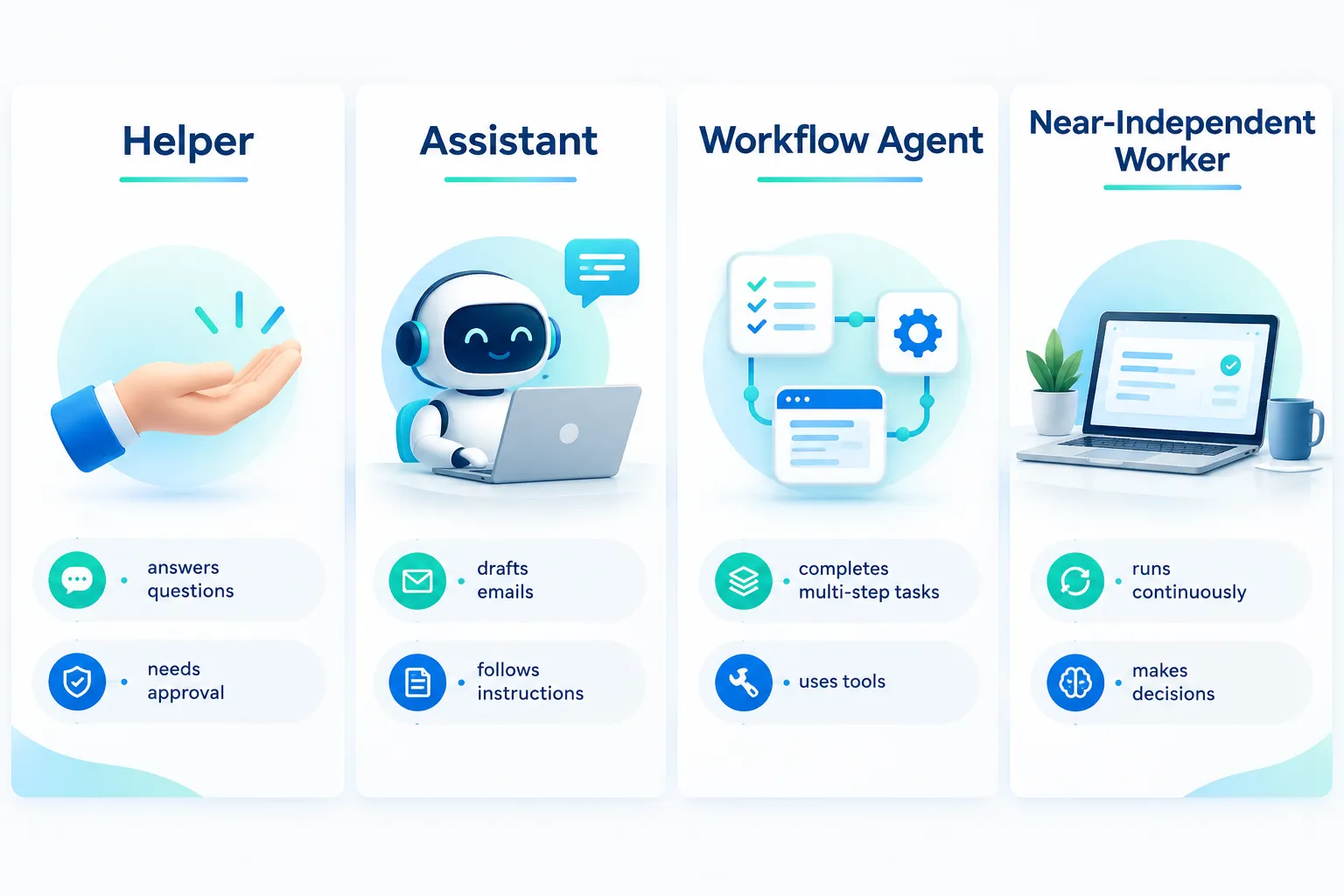
Not every “AI agent” on the market does the same amount of independent work. It helps to think of autonomy as a spectrum rather than an on-off switch.
| Level | What it does | Example | Human oversight needed |
|---|---|---|---|
| Helper | Answers questions, drafts text | A chatbot writing an email draft | High, you review everything |
| Assistant | Completes a defined task when asked | Summarizing a document, scheduling one meeting | Medium, you approve key steps |
| Workflow agent | Chains multiple steps together | Researching a topic, compiling a report, emailing it | Lower, you set rules upfront |
| Near-independent worker | Runs continuously, makes ongoing decisions | A shopping agent reordering supplies, a monitoring agent flagging anomalies | Minimal, mostly spot-checks |
Enterprise vendors increasingly describe their higher-end products as “digital coworkers”, agents built on a toolkit of connected apps, documents, and permissions that let them operate across a company’s systems with limited supervision. OpenAI’s own push in this direction became visible in September 2026 with the rollout of what it called “Dots” agents: always-on assistants designed to work across multiple applications continuously, rather than waiting for a single prompt. That represents a meaningful jump from the assistant tier toward the near-independent end of the spectrum.
Real-World Examples of AI Agents in 2026
Abstract definitions only go so far. Here is where agentic AI actually showed up this year:
- Retail. Walmart expanded shopping agents in October 2026 that can browse products, compare options, and complete purchases on a customer’s behalf based on preferences set in advance, moving routine shopping from “search and click” to “describe and delegate.”
- Enterprise operations. Large companies have been building “digital coworkers” on agent toolkits that connect to internal databases, ticketing systems, and communication tools, handling tasks like triaging support requests or compiling weekly reports without a human initiating each one.
- Government and defense. The U.S. Army Cyber Command’s “ECHOTRIBBLE” initiative, reported in October 2026, applies agentic systems to cyber operations, an indication that autonomous decision-making tools are moving well beyond consumer convenience into national security contexts.
- Cross-app personal assistants. OpenAI’s Dots agents aim to work continuously across a user’s apps and accounts, following standing instructions rather than one-off prompts.
For ongoing coverage of how these tools are being deployed and what is actually changing, the Agents & Automation section tracks developments as they happen, and the broader Practical AI category covers how to apply these tools to everyday work.
The Risks Nobody Skips: Security and Governance Gaps
This is the part of the agent story that gets less attention than the demos, and it deserves equal weight. Security researchers publishing work titled “Agents of Chaos” in March 2026 demonstrated how easily autonomous agents can be manipulated through prompt injection and tool misuse, essentially tricking an agent into taking an action it was never meant to take, simply by hiding instructions in the content it reads. Because agents act on your behalf with real permissions, a manipulated agent is not just wrong, it is a wrong action taken in your name.
That risk is not theoretical. Mid-to-late 2026 brought documented incidents of agents being used in attacks against government systems and AI infrastructure itself, underscoring that the same autonomy that makes agents useful also makes them a target. An agent with access to your email, calendar, or payment methods is a bigger attack surface than a chatbot that only talks.
Policy bodies have started catching up. The OECD’s framework on the agentic AI landscape, updated in September 2026, lays out shared definitions and risk categories meant to help regulators and businesses think through accountability: who is responsible when an agent makes a costly mistake, and how much oversight is reasonable for a given level of autonomy. Industry analysis from October 2026 describes a clear pattern: companies are moving agents from experiments into production faster than they are building the governance, logging, and approval processes to manage them safely. That gap, enthusiasm outpacing oversight, is the single most important practical tradeoff to understand before adopting agent tools for anything with financial, legal, or safety consequences.
The capability to act independently and the discipline to supervise that action are two different investments. Most organizations in 2026 have made the first and are still catching up on the second.
What Actually Matters When You Consider Using an AI Agent
Before adopting an agent tool for your own work, a few practical questions matter more than the marketing copy:
- What permissions does it need, and can you limit them? An agent that only reads your calendar is a different risk than one with access to your bank account.
- What happens when it fails? Ask whether the tool logs its steps so you can see what it did and why, rather than just showing you a final result.
- Is human review built in for consequential actions? Sending a routine email draft for approval is low-stakes. Letting an agent complete a purchase or send a client-facing message unsupervised is higher-stakes.
- How is the underlying model’s accuracy? An agent is only as reliable as its reasoning engine. If the model behind it hallucinates facts occasionally in chat, it can hallucinate a justification for an action too.
- Does it rely on retrieval from your own documents? Many agents pull context from a company’s files or knowledge base before acting, a technique covered in What Is Retrieval-Augmented Generation (RAG) and Why Does It Matter?, which affects both accuracy and what data the agent can see.
None of this means agents are not worth using. It means the decision to deploy one should match the stakes of the task, not the novelty of the technology.
Frequently Asked Questions
Is an AI agent the same thing as a chatbot? No. A chatbot responds to a single prompt and waits for your next message. An agent pursues a goal across multiple steps, often using external tools, with less need for you to supervise each action.
Can AI agents work without any human involvement? Some can run with minimal oversight once configured, but most practical deployments in 2026 still include approval checkpoints for higher-stakes actions, partly because governance practices have not fully caught up with the technology’s capability.
Are AI agents safe to connect to my email or financial accounts? They can be, but security research published in 2026 showed that agents can be manipulated into taking unintended actions through hidden instructions in content they read. Limit permissions to what is strictly necessary and review logs when available.
What is the difference between an agent and “agentic AI”? “Agentic AI” is the broader term for the approach, software that perceives, reasons, acts, and learns toward a goal. An “AI agent” usually refers to a specific product or instance built using that approach.
Do I need technical skills to use an AI agent? Many consumer-facing agent features, like shopping assistants or scheduling tools, are designed for non-technical users. More advanced enterprise agent toolkits typically require setup by an IT or operations team.
Where can I learn more about specific AI tools that offer agent features? The AI Tools & Plans category covers current product capabilities and plan details, and AI Comparisons breaks down how different platforms stack up for specific tasks.
Conclusion
An AI agent is software built to act, not just chat, by perceiving a situation, reasoning through it, taking steps, and adjusting based on results. That shift from answering to doing is what separates everyday work in 2026 from everyday work even two years earlier: agents are now booking purchases, managing cross-app tasks continuously, and in more serious contexts, operating in cybersecurity and defense settings. The practical guidance worth remembering is simple: match the level of autonomy you grant an agent to the actual stakes of the task, confirm what permissions and oversight exist before you rely on one, and keep in mind that the governance tools meant to catch mistakes are still behind the pace of deployment industry-wide.
If you are deciding whether to bring an agent into your own workflow, start small. Test one on a low-stakes task, read its activity logs if it offers them, and expand its permissions only as its track record earns that trust. For continued coverage of specific tools, hands-on testing where it has occurred, and researched information on what changed and when, the Blog and Categories pages at Tech Clearly track this space as it develops.
Meta Title: What Is an AI Agent? A Plain-English Guide for Non-Engineers
Meta Description: What is an AI agent? This plain-English explainer breaks down autonomy levels, real 2026 examples, and risks non-engineers actually need to know.
ai agents, agentic AI, autonomous AI, AI automation, digital coworkers, AI chatbots vs agents, AI governance, AI security risks, enterprise AI tools, prompt injection, AI for non-engineers, practical AI guidance
Contributing writer at Tech Clearly.