

What Is Retrieval-Augmented Generation (RAG) and Why Does It Matter?
An AI model that sounds confident and an AI model that is correct are not the same thing. That gap, between fluent and accurate, is the single biggest reason retrieval-augmented generation exists. If you have ever asked a chatbot a question and gotten an answer that was polished, specific, and completely wrong, you already understand the problem RAG was built to solve.
This article explains what is retrieval-augmented generation (RAG) and why does it matter for anyone using AI tools at work, from freelancers drafting client reports to IT teams rolling out internal assistants. The short version: RAG connects a language model to real, current information instead of relying only on what the model memorized during training. The longer version, including where it still falls short, follows below.
Key Takeaways
- Retrieval-augmented generation (RAG) pairs a language model with a search step, pulling in relevant documents before the model writes its answer.
- RAG reduces hallucinations by grounding responses in retrieved, verifiable source material rather than pure memorized pattern-matching.
- Newer approaches, including hybrid retrieval, knowledge-graph RAG, and multilingual retrieval benchmarks, are improving accuracy and consistency through 2026.
- RAG is not immune to error. Noisy, outdated, or adversarial source documents can still produce confident but wrong answers.
- Enterprises are adopting RAG architectures for internal search, customer support, and research tools rather than replacing it with fine-tuning alone.
What Is Retrieval-Augmented Generation (RAG) and Why Does It Matter Right Now?
Retrieval-augmented generation is a method where an AI system searches a trusted set of documents, pulls out the most relevant passages, and feeds those passages to the language model along with the user’s question. The model then writes an answer based on what it just read, not purely on what it memorized months or years earlier during training.
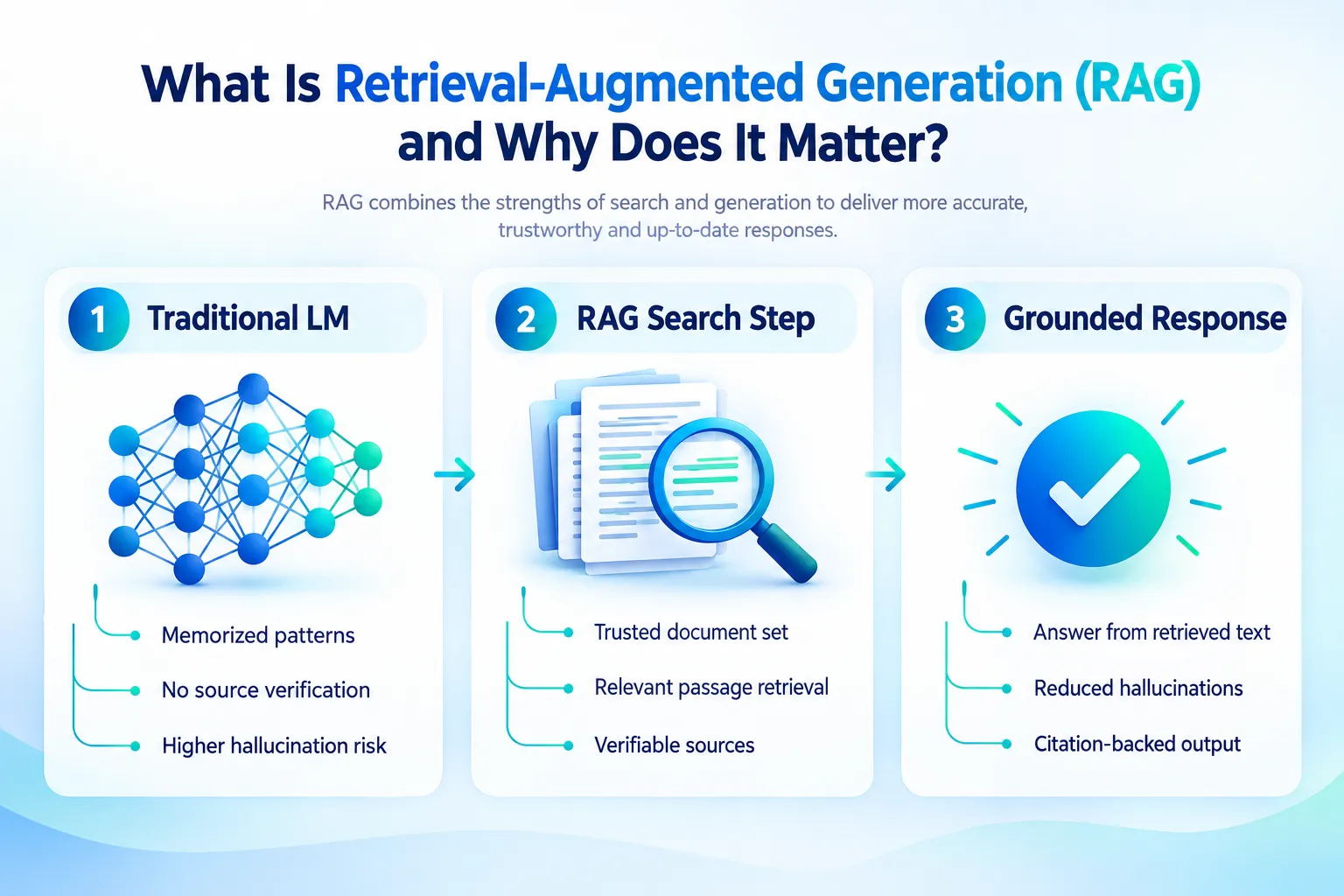
Think of a standard large language model as a very well-read employee who has not opened a new book since training ended. RAG hands that employee the latest file from the cabinet before they answer your question. The model still does the writing, but the facts come from a live source rather than an old memory.
This matters right now because AI tools are moving from novelty to daily infrastructure. Professionals use chatbots for research, customer support teams rely on AI for product questions, and consultants ask AI to summarize internal documents. In every one of those cases, an answer that invents a policy, a statistic, or a product feature is a liability, not a convenience. RAG is the primary technique the industry uses to narrow that risk.
For readers comparing general-purpose assistants, it helps to understand that not every chatbot uses RAG the same way, or at all. Tools covered in ChatGPT vs Claude vs Gemini: Which AI Fits Your Work Style? increasingly add retrieval features for web search and document upload, but the depth and reliability of that retrieval varies by product and plan.
How RAG Actually Works, Step by Step
Underneath the marketing language, RAG follows a fairly mechanical process. Understanding the steps helps explain both its strengths and its failure points.
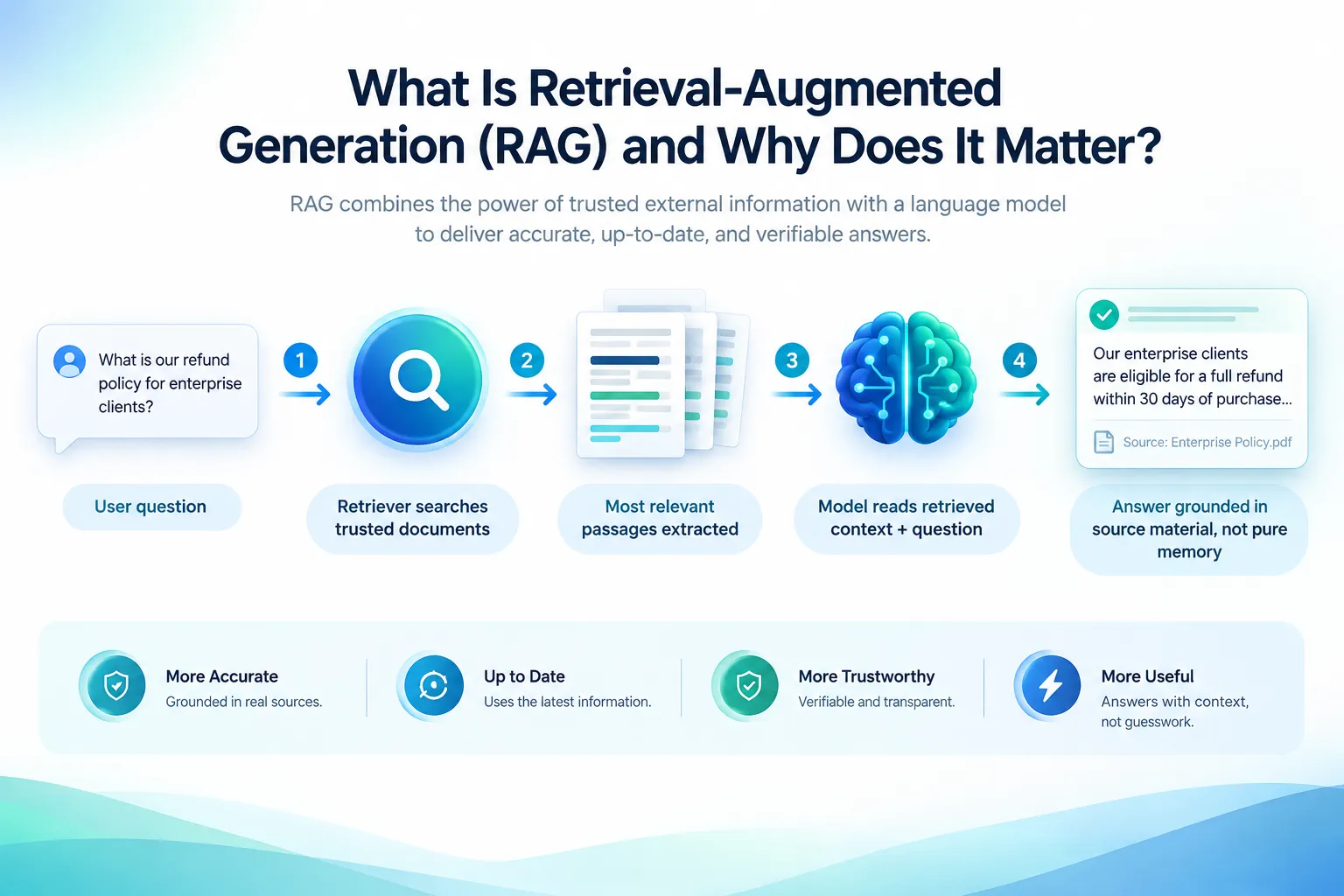
- The question arrives. A user types a prompt, such as “What is our current refund policy for enterprise clients?”
- The retriever searches a knowledge source. This could be a company’s internal document library, a product manual, a legal database, or the open web, depending on the setup.
- Relevant passages are ranked and selected. Older RAG systems used simple keyword matching. Current systems typically use a mix of keyword search and vector-based semantic search, known as hybrid retrieval, because each method catches things the other misses.
- The passages are added to the prompt. The model receives the original question plus the retrieved text, often with source labels attached.
- The model generates a grounded answer. Instead of answering from memory alone, the model writes a response that references the retrieved material, and well-designed systems include citations pointing back to the source documents.
This is also where quality control decisions get made. Some systems retrieve a handful of passages per query; others run two retrieval passes, a broad first pass followed by a narrower re-ranking pass, sometimes called a dual-pipeline approach. The extra step costs a little speed but tends to improve accuracy, particularly for longer or more technical documents.
Core Benefits: Reduced Hallucinations and Better Grounding
The headline benefit of retrieval-augmented generation is a meaningful drop in hallucination rates. A language model answering purely from memory has to guess when its training data is thin, outdated, or simply absent for a given topic. A model working from retrieved documents has something concrete to check its answer against.
This matters for a specific set of everyday work tasks:
- Internal knowledge search. Employees asking an AI assistant about HR policy, pricing rules, or technical documentation get answers sourced from the actual current documents, not a guess based on general training data.
- Customer support. A support bot grounded in a product’s real help center content is far less likely to invent a feature that does not exist.
- Research and writing. Consultants and analysts can ask an AI tool to summarize a specific report rather than risk it blending in unrelated information from training.
- Compliance-sensitive industries. Legal, financial, and healthcare teams benefit from citation-focused RAG, where every claim in the output links back to a traceable source document, which matters for audit trails as much as accuracy.
A pull quote worth remembering when evaluating any AI tool that claims to “search your documents”:
Grounding does not mean perfection. It means the model’s answer can be checked against something real, instead of taken on faith.
That distinction is why reduced hallucination is the right framing rather than eliminated hallucination. Retrieval lowers the odds of fabrication significantly, but it does not remove the model’s ability to misread, overgeneralize, or blend retrieved passages incorrectly.
What Changed in 2025 and 2026: Benchmarks, Hybrid Retrieval, and Graph-Based RAG
RAG research moved from experimental technique to a formally benchmarked field over the past two years. The NIST TREC RAG Track, a structured evaluation program that expanded through 2025 and was updated again in October 2026, now gives researchers and vendors a standardized way to measure retrieval accuracy and answer quality at scale, rather than relying on isolated internal tests. That matters for buyers because it means claims about RAG performance can increasingly be checked against shared, public benchmarks instead of vendor-only marketing numbers.
Several technical developments are shaping what “good RAG” looks like heading into 2026:
Hybrid retrieval combines traditional keyword search with semantic vector search, catching both exact-term matches and conceptually related content that a pure keyword search would miss. Most serious enterprise RAG deployments now use some version of this dual approach rather than relying on vector search alone.
Knowledge-graph and structure-aware RAG, including approaches researchers describe as KG2RAG and GraphRAG, organize retrieved information around relationships between entities rather than treating documents as flat blocks of text. This helps with questions that require connecting multiple facts, such as “which vendors supply parts used in products that failed quality checks last quarter,” where a plain document search often misses the connective logic.
Multilingual and cross-lingual RAG has become its own research area, tracked through efforts like the RAGTIME benchmark track, which evaluates how well retrieval systems perform when the question is asked in one language but the source documents exist in another. This matters directly for global businesses and any organization serving customers in multiple languages, since retrieval quality has historically dropped sharply outside English-language content.
Mid-2025 systematic reviews and surveys of the RAG field remain the most authoritative reference points going into 2026, largely because the core architecture has stabilized even as individual techniques improve. Readers tracking these shifts closely may find ongoing coverage useful in Tech Clearly’s AI & Tech Updates section, where model and benchmark changes are tracked as they are verified.
Where RAG Still Struggles: Robustness Challenges
RAG is not a universal fix, and treating it as one creates its own risk. Retrieval systems are only as good as what they retrieve, and research through 2025 and 2026 has repeatedly surfaced the same categories of failure.
Noisy retrieval happens when the search step pulls back documents that are topically related but not actually relevant to the specific question, and the model then builds an answer on a weak foundation. Adversarial retrieval is a more deliberate version of the same problem, where manipulated or low-quality content designed to mislead gets ranked highly enough to influence the model’s output. This is a growing concern for any RAG system that pulls from the open web rather than a curated internal document set.
Other practical limitations worth knowing before relying on RAG for anything high-stakes:
| Challenge | What It Means in Practice |
|---|---|
| Outdated source documents | If the knowledge base is not refreshed, RAG will confidently repeat stale information |
| Conflicting sources | When retrieved documents disagree, the model may blend them into an answer that sounds coherent but is factually mixed |
| Over-retrieval | Pulling too many documents can bury the truly relevant passage in noise |
| Citation mismatch | Some systems generate citations that look correct but point to the wrong passage |
| Domain mismatch | A RAG system tuned for legal documents may perform poorly on casual support tickets, and vice versa |
None of this means RAG is unreliable as a category. It means RAG quality depends heavily on the discipline behind it, how the source documents are curated, how often they are updated, and how the retrieval and ranking steps are tuned. A RAG system pointed at a messy, unmaintained file share will underperform a system pointed at a clean, regularly updated knowledge base, even if both use the same underlying language model.
Enterprise Adoption: How Companies Are Using RAG in 2026
Through 2025 and into 2026, major cloud and AI providers, including Google, Microsoft, and IBM, published reference architectures showing how enterprises typically deploy RAG in production. The common pattern across these approaches looks similar regardless of vendor: a document ingestion pipeline that cleans and indexes internal content, a retrieval layer that combines keyword and vector search, and a generation layer where the language model produces the final answer with source citations attached.
Typical enterprise use cases researched across this period include:
- Internal help desks that answer employee questions from HR and IT documentation instead of routing every ticket to a human.
- Customer-facing support assistants grounded in product documentation and past support tickets.
- Research and legal document review, where RAG helps staff locate relevant clauses or precedents across large document sets faster than manual search.
- Sales enablement tools that pull accurate, current product specs into proposal drafts.
Small businesses and freelancers are adopting lighter versions of the same idea, often through AI tools that let users upload documents directly into a chat session rather than building a full retrieval pipeline. For teams exploring whether to build custom RAG workflows or use existing AI assistants with document upload features, Tech Clearly’s Agents & Automation coverage walks through practical setup choices, and the Productivity & Workflows section covers how these tools fit into daily task management.
RAG vs Fine-Tuning vs Long-Context Models: Practical Tradeoffs
A common point of confusion is whether RAG competes with other ways of giving an AI model specialized knowledge, specifically fine-tuning and long-context models that can read enormous documents directly in the prompt. The honest answer is that these are different tools for different jobs, and the practical tradeoffs matter more than any single “best” option.
| Approach | Best For | Key Limitation |
|---|---|---|
| RAG | Frequently changing information, large document libraries, needing citations | Quality depends entirely on retrieval accuracy |
| Fine-tuning | Teaching a model a specific style, tone, or narrow skill | Expensive to update, does not add new factual knowledge well |
| Long-context prompting | Smaller, stable document sets that fit entirely in one prompt | Costly at scale, can still lose track of details in very long inputs |
Many production systems in 2026 actually combine these approaches rather than choosing one. A model might be lightly fine-tuned for tone, then paired with RAG for factual grounding, with long-context handling used for shorter, self-contained documents that do not need a full retrieval pipeline. The right combination depends on how often the underlying information changes and how much citation traceability the use case requires.
Readers weighing these options side by side for their own workflows may find it useful to review how different assistants handle document grounding in AI Comparisons, and general guidance on evaluating AI tool capabilities in Practical AI.
What Is Retrieval-Augmented Generation (RAG) and Why Does It Matter for Everyday Work?
Stepping back from the technical layer, the practical question for most readers is simpler: does this change how you should use AI day to day? The answer is yes, in a specific way. When choosing an AI tool for research, customer support, or document-heavy work, ask whether it retrieves and cites sources or answers purely from memory. Tools that show their sources are generally more trustworthy for factual work, even if they are occasionally slower or more conservative in tone.
For anyone troubleshooting an AI assistant that keeps producing wrong or outdated answers, checking whether it has retrieval enabled, and whether the connected documents are current, is one of the first diagnostic steps worth trying. Tech Clearly’s AI Troubleshooting section covers additional steps for diagnosing inaccurate AI output beyond retrieval settings alone.
Looking Ahead: RAG Through the Rest of 2026
Based on current research trends, several developments look likely to continue through the rest of 2026. Knowledge-graph RAG is expected to move from research papers into more mainstream enterprise products, particularly for industries where facts connect across many documents, such as legal and compliance work. Multilingual retrieval benchmarks like RAGTIME should keep pushing vendors to close the accuracy gap between English and other languages. And citation-focused RAG, where every claim is traceable to a specific source, is likely to become a baseline expectation rather than a premium feature, especially as regulators in finance and healthcare pay closer attention to AI-generated content.
Frequently Asked Questions
Is RAG the same as fine-tuning a model? No. Fine-tuning changes the model’s internal weights through additional training, which is better for adjusting tone or teaching a narrow skill. RAG leaves the model unchanged and instead feeds it retrieved documents at the moment of the question, which works better for factual accuracy on changing information.
Does RAG completely stop AI hallucinations? No. RAG reduces hallucinations by grounding answers in retrieved documents, but it does not eliminate the risk entirely. Noisy retrieval, conflicting sources, or poorly maintained document collections can still lead to incorrect answers.
Do consumer chatbots like ChatGPT use RAG? Many do, in limited forms, particularly when web search or document upload features are enabled. The depth of retrieval varies by plan and product. Readers comparing these features may find ChatGPT Plus vs Free: Is the $20 Plan Worth It? useful for understanding what retrieval and search features are included at each tier.
Is RAG only useful for large companies? No. Small businesses and freelancers can use lightweight versions of RAG simply by uploading reference documents directly into AI chat tools that support file attachments, without needing a custom-built retrieval pipeline.
How can I tell if an AI answer is actually grounded in a real source? Look for inline citations or document references in the response. If an AI tool cannot show where an answer came from, treat the output as unverified and check it against a primary source before relying on it for decisions.
Will RAG eventually be replaced by models with much larger context windows? Unlikely in the near term. Even as context windows grow, searching and ranking relevant information remains more efficient and more citation-friendly than loading entire document libraries into every prompt. The two approaches are more likely to keep being combined than to replace one another.
Conclusion
Retrieval-augmented generation is less a single product feature and more a design principle: do not make an AI model guess when it can check. That principle has moved from research labs into mainstream products, formal benchmarks, and enterprise reference architectures over the past two years, and the practical payoff is real for anyone who needs AI answers to be checkable, not just confident.
The practical next step is straightforward. Before relying on any AI tool for factual, document-heavy, or customer-facing work, check whether it retrieves from real sources, whether it cites what it used, and how current those sources are. Those three questions tell you more about reliability than any marketing claim. For readers who want to keep track of how retrieval features evolve across major AI tools, Tech Clearly’s Research & Documents coverage tracks these changes as they are verified, with dates noted so readers know what information reflects the most recent product updates.
Meta Title: What Is Retrieval-Augmented Generation (RAG) and Why It Matters
Meta Description: What is Retrieval-Augmented Generation (RAG)? A clear, practical guide to how RAG works, its benefits, limitations, and why it matters for AI accuracy in 2026.
retrieval-augmented generation, RAG explained, AI hallucinations, grounded AI answers, hybrid retrieval, knowledge graph RAG, GraphRAG, multilingual RAG, enterprise AI adoption, AI citations, vector search, large language models
Contributing writer at Tech Clearly.