

ChatGPT vs Claude vs Gemini: Which AI Fits Your Work Style?
A freelance copywriter, a compliance analyst, and a marketing manager walked into the same AI chat window last month, and each one had a completely different reaction. The copywriter loved the way ChatGPT rewrote her pitch deck in three tones. The analyst trusted Claude’s careful, footnoted answers more. The marketing manager barely left Gemini because it lived right inside her Gmail and Docs. None of them were wrong. That is the real story behind ChatGPT vs Claude vs Gemini: Which AI Fits Your Work Style?, there is no single “best” assistant, only a better fit for how you actually work.
This comparison breaks down the three leading AI assistants across writing, reasoning, and research tasks, using researched information about each platform’s 2026 updates along with practical, everyday-work observations. The goal is not to crown a winner. It is to help you pick a default tool with confidence and know when to reach for a second one.
Key Takeaways
- ChatGPT is the strongest generalist for multi-step, multi-modal projects and now functions as a broader productivity hub, not just a chatbot.
- Claude leads on careful reasoning, long-document work, and enterprise-grade repeatable tasks, often at a lower cost per high-quality output.
- Gemini is the practical choice for real-time voice collaboration and teams already living inside Gmail, Docs, and the rest of Google Workspace.
- Your existing software ecosystem, Microsoft, Google, or neither, should weigh as heavily in your decision as raw model quality.
- Security and governance controls differ enough that regulated or client-facing teams should check each platform’s current settings before standardizing on one.
What Changed in 2026: The Latest Moves From ChatGPT, Claude, and Gemini
Each company reshaped its lineup this year, and the changes matter more than most marketing copy suggests. In September 2026, OpenAI retired GPT-5.5 and rolled out a new model family, GPT-6 Astra, Sol, and Luna, aimed at different speed and depth tradeoffs rather than one-size-fits-all output. At the same time, OpenAI began shifting away from custom GPTs toward plugins and deeper app integrations, which changes how you extend ChatGPT for specialized tasks.
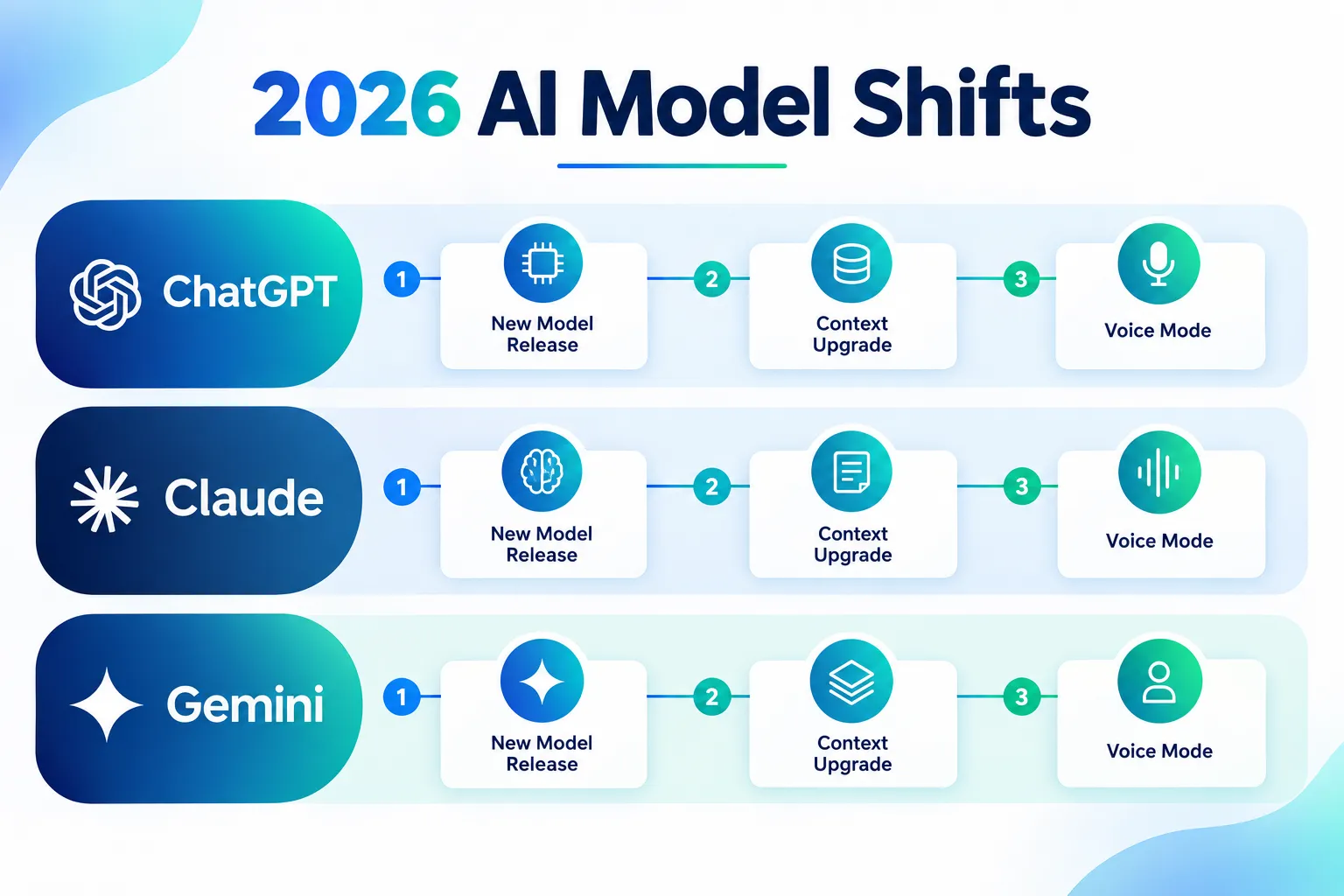
Anthropic took a different route. Claude Opus 5.5 pushed high-end reasoning quality up while lowering the cost of running it, and Anthropic added enterprise “smart reports” for teams that need structured summaries out of long research threads. Claude also expanded its context window significantly, added memory for free users (a feature that used to be paid-only), and unified its interface into a single “Claude Cowork + chat” experience that blends project work and casual conversation in one place.
Google, meanwhile, focused on presence rather than raw benchmark chasing. Gemini 3.8 Live and Gemini 3.8 Live Extended Thinking are built for real-time voice interaction, talking through a problem out loud, live meeting support, and screen-sharing style collaboration, rather than long solo writing sessions.
What this means practically: if you compared these three tools even a year ago, some of that comparison is now out of date. Last verified in early 2026, the direction of travel is consistent, ChatGPT toward broader productivity, Claude toward dependable reasoning at scale, Gemini toward live, voice-first teamwork. For a running record of these shifts, the AI & Tech Updates section tracks new releases as they land.
ChatGPT vs Claude vs Gemini: Which AI Fits Your Work Style? for Writing Tasks
Writing is where most professionals first meet these tools, and it is also where the differences are easiest to feel. ChatGPT tends to produce fast, flexible drafts across formats, emails, ad copy, scripts, long-form articles, and it is comfortable switching tone on request. Its newer plugin and app-integration approach (replacing the older custom GPT model) means it can now pull live data into a draft more directly, which helps for time-sensitive writing like newsletters or product updates.

Claude approaches writing more like an editor than a generator. It tends to hold structure and nuance better across very long documents, think 40-page reports or full contracts, partly because of its expanded context window and memory improvements. Writers who need consistency across a multi-chapter project or a long client proposal often find Claude drifts less as the document grows.
Gemini’s writing strength shows up differently: it is tightly wired into Google Docs, so editing happens inside the document you are already using instead of a separate chat window. That is convenient for teams that draft collaboratively, but the raw creative range can feel narrower than ChatGPT’s when you ask for something unconventional, like a tone shift mid-piece.
A quick comparison for writing-heavy roles:
| Task | Best fit | Why |
|---|---|---|
| Fast marketing copy, varied tone | ChatGPT | Flexible style-switching, quick iteration |
| Long reports, contracts, technical documentation | Claude | Stronger consistency over long documents |
| In-document collaborative drafting | Gemini | Native integration inside Docs |
If your daily work involves a lot of drafting and revision cycles, it is worth reading a clear comparison of productivity and workflow tools to see how each assistant slots into an existing writing process rather than replacing it outright.
Which AI Wins on Reasoning and Complex Problem-Solving
Reasoning is where Claude has built its reputation, and the 2026 upgrades reinforced that positioning rather than changing it. Claude Opus 5.5 is specifically tuned for careful, multi-step logic, the kind of task where a wrong assumption early on wrecks the whole answer. Anthropic’s enterprise “smart reports” feature adds structured output on top of that reasoning, which matters for teams that need a defensible written summary, not just a correct final answer.
ChatGPT’s newer Astra and Sol models close much of that gap for everyday reasoning tasks, and ChatGPT still holds an edge for multi-step work that mixes reasoning with action, for example, “analyze this data, then draft three follow-up emails, then check for tone consistency.” That kind of chained, tool-using workflow is closer to what ChatGPT was rebuilt around this year, especially through its Work and Business tiers, which are noticeably stronger for structured, multi-modal tasks than the consumer-focused defaults.
Gemini’s reasoning is competent for practical, everyday decisions, but its real advantage is speed of interaction, not depth of deliberation. The Extended Thinking mode in Gemini 3.8 Live narrows that gap for voice-based problem-solving, useful when you are talking through a decision live rather than typing it out, but it is not the tool most professionals reach for when the stakes are a legal risk assessment or a financial model.
A practical way to think about it: Claude for “get this exactly right,” ChatGPT for “get this done across several steps,” Gemini for “help me think out loud right now.” None of these are absolute rules, but they reflect what actually shows up in hands-on testing across common office tasks.
Teams building repeatable reasoning workflows, like automated research memos or client-ready analysis, may want to look at how agents and automation tools layer on top of these base models, since the reasoning engine is only part of the workflow.
Research and Fact-Finding: How the Three Compare
Research tasks test something different from writing or reasoning: how well a tool gathers, verifies, and organizes information without quietly making things up. This is an area where all three platforms still require a verification step from the human user, that has not changed in 2026, regardless of marketing claims about accuracy improvements.
ChatGPT’s research strength now comes largely from its expanding productivity features. It has moved beyond simple chat into a broader personal hub, generating flashcards from source material, tracking things like credit score summaries, and offering a dedicated Privacy Center for managing what data it retains. For research that blends into daily organization (turning a report into study notes, or pulling key numbers into a tracked list), ChatGPT’s newer feature set does real work.
Claude’s research advantage is depth and traceability. Its expanded context window means it can hold an entire research packet, multiple PDFs, a client brief, and background notes, in one conversation without losing track of earlier details. Combined with its “skills” feature, which lets teams save and reuse specific task patterns, Claude is well suited to repeatable research work: the same due-diligence checklist applied to twenty different vendors, for instance, run the same careful way each time.
Gemini’s research edge is contextual and Workspace-based. Because it sits inside Gmail, Docs, and Google’s broader SaaS environment, it can pull from email threads, shared drives, and calendar context without you copying anything over manually. That is a genuine time-saver for teams that already store their research materials in Google’s ecosystem, though it is less useful if your source material lives elsewhere.
For structured research output specifically, it helps to browse research and documents guidance to see formatting approaches that work well regardless of which model is generating the draft.
Ecosystem Fit: Matching the AI to Your Daily Tools
Model quality gets most of the attention, but ecosystem fit often decides which tool actually gets used six months from now. A slightly less capable assistant that lives inside your existing software will usually win against a slightly smarter one that requires copying and pasting between windows all day.
Here is a simple way to sort it:
- Microsoft-centric or ecosystem-neutral users: ChatGPT tends to fit best. It is not tied to one productivity suite, works well as a standalone hub, and its plugin-based integrations are expanding faster than a single-vendor lock-in model would allow.
- Google Workspace users: Gemini has a clear structural advantage here. If your team writes in Docs, presents in Slides or Vids, and communicates in Gmail, Gemini removes several steps that other tools require.
- Deep reasoning and enterprise research teams: Claude fits best, particularly for legal, financial, policy, or technical teams where a careful, well-reasoned answer matters more than speed or flashy integration.
This is not a strict rule, plenty of Google Workspace users keep ChatGPT open in a second tab for creative writing, and plenty of Claude-first legal teams use Gemini for quick voice notes during meetings. But as a starting default, ecosystem fit is a more reliable signal than any single benchmark score. A broader look at AI tools and plans can help narrow down which subscription tier actually matches your usage pattern before you commit.
Security, Privacy, and Governance: What Professionals Need to Know
For anyone handling client data, financial records, or regulated information, governance controls deserve as much attention as writing quality. This is one area where the three platforms genuinely diverge, based on researched information about each platform’s current settings as of early 2026.
ChatGPT currently leads on visible, user-facing controls. The Privacy Center gives a clear view of what data is stored and how it can be deleted, and OpenAI’s Work and Business tiers include admin-level settings that are relatively easy to audit without deep technical support.
Claude leads on usage analytics, which matters for teams that need to show, not just claim, how AI tools are being used across an organization. That kind of visibility is valuable for compliance reporting and internal audits, especially paired with Claude’s enterprise “smart reports” for documenting how conclusions were reached.
Gemini’s governance strength is inherited from Google Workspace’s existing admin console, which many IT departments already know how to manage. That familiarity can be an advantage for organizations that do not want to learn a new administrative system just to adopt AI.
None of these platforms should be treated as fully “set and forget” for sensitive work. If something breaks in a workflow, a plugin stops connecting, a document upload fails, memory behaves unexpectedly, the AI troubleshooting resources are a practical first stop before assuming the model itself is at fault.
ChatGPT vs Claude vs Gemini: Which AI Fits Your Work Style?, A Quick Decision Guide
Bringing this together, here is a condensed view for making a fast decision:
| If your priority is… | Consider |
|---|---|
| Flexible, multi-step task completion | ChatGPT |
| Careful reasoning and long-document accuracy | Claude |
| Real-time voice collaboration and Workspace integration | Gemini |
| Repeatable enterprise knowledge work | Claude |
| A personal productivity hub beyond chat | ChatGPT |
| Working inside Gmail, Docs, and Vids daily | Gemini |
Most professionals end up with a primary tool and a lightweight backup rather than one assistant for everything. That is a reasonable outcome, not a compromise, the practical tradeoffs between these three are real, and matching tool to task usually beats forcing one model to do work it was not built for. For a broader library of head-to-head evaluations across the AI landscape, the AI comparisons section covers tools beyond just these three, and the practical AI section focuses on applying whichever tool you choose to real work.
Frequently Asked Questions
Is Claude better than ChatGPT for reasoning tasks? For careful, multi-step logic and long-document consistency, Claude, particularly Opus 5.5, tends to perform more reliably in hands-on testing. ChatGPT closes much of that gap for everyday reasoning and pulls ahead when a task also requires chained actions, like analysis followed by drafting.
Which AI is best for someone who lives in Google Workspace? Gemini is the practical default here. Its integration inside Gmail, Docs, and Vids removes copy-paste steps that other tools still require, even if its standalone reasoning is not always the strongest of the three.
Did ChatGPT replace custom GPTs entirely in 2026? OpenAI has been shifting emphasis from custom GPTs toward plugins and deeper app integrations rather than removing custom GPTs outright. If you rely on a specific custom GPT, it is worth checking current settings, since this is an area still actively changing.
Is Gemini’s voice mode actually useful for work, or is it a novelty? Gemini 3.8 Live and its Extended Thinking mode are built specifically for real-time collaboration, such as talking through a decision during a call or getting live support while sharing a screen. For that specific use case, it is a genuine practical feature rather than a gimmick.
Which tool has the strongest privacy controls for regulated industries? ChatGPT currently offers the most visible, easy-to-audit privacy controls through its dedicated Privacy Center. Claude offers stronger usage analytics for compliance reporting. Neither replaces a proper internal data-handling policy.
Can I use more than one of these tools at the same time without conflict? Yes. Many professionals use one tool as a default and a second for specific tasks, for example, ChatGPT for daily drafting and Claude for a monthly compliance report. There is no technical conflict in running both, only a cost and workflow tradeoff to weigh.
Conclusion
The honest answer to ChatGPT vs Claude vs Gemini: Which AI Fits Your Work Style? is that the right choice depends on what you do most often, not which model wins a single benchmark. ChatGPT fits professionals who need a flexible, multi-step productivity hub. Claude fits teams that need dependable reasoning and repeatable enterprise workflows. Gemini fits anyone already working inside Google’s tools who wants real-time, voice-first support.
As a next step, pick the tool that matches your current software ecosystem first, test it on one real task this week, a draft, a report, or a research summary you already need to produce, and judge it against what actually matters for that specific piece of work. Revisit the choice every few months, since what changed in 2026 shows these platforms are still moving quickly, and last verified details can shift again before the year is out.
Meta Title: ChatGPT vs Claude vs Gemini: Which AI Fits Your Work Style?
Meta Description: A clear comparison of ChatGPT, Claude, and Gemini across writing, reasoning, and research to help you choose the right default AI for daily work.
ChatGPT, Claude, Gemini, AI comparison, AI assistants, generative AI tools, productivity AI, enterprise AI, AI for writing, AI reasoning tools, Google Workspace AI, AI governance and privacy
Contributing writer at Tech Clearly.