

AI Hallucinations Explained: Why AI Makes Things Up and How to Catch It?
A federal judge sanctioned lawyers for filing briefs with fake case citations. A military planning tool reportedly fed near-fabricated intelligence into a live operational review this spring. A spreadsheet formula generated by an AI assistant quietly invented data that looked completely real. None of these were random glitches. They were hallucinations, and understanding why they happen is now a basic requirement for anyone who uses AI tools for real work.
This piece on AI Hallucinations Explained: Why AI Makes Things Up and How to Catch It breaks down what actually causes AI to invent facts, why the problem is structural rather than a bug waiting to be patched, and what practical steps catch false information before it reaches a client, a court, or a decision-maker.
Key Takeaways
- AI hallucinations are a built-in side effect of how language models predict text, not just occasional software errors.
- Research from 2026 shows hallucinations are mathematically unavoidable to some degree, even in well-trained models.
- Real-world consequences are escalating, including legal sanctions tied to thousands of court filings and a near-miss military planning incident in spring 2026.
- Structured outputs like SQL queries, JSON records, and spreadsheets hallucinate just as often as plain text, sometimes more.
- Practical detection, cross-checking sources, ensemble comparisons, and uncertainty flags, catches far more errors than trusting a confident-sounding answer.
What “AI Hallucination” Actually Means in 2026
A hallucination is any output that an AI presents as fact when it is actually invented, wrong, or unsupported by real evidence. That includes fake citations, nonexistent statistics, incorrect dates, misattributed quotes, and confidently wrong code. The term has stuck because the behavior resembles human confabulation, the AI isn’t lying in the human sense, it’s filling gaps with plausible-sounding content because that is literally what it was trained to do.
By 2026, the definition has broadened beyond chat responses. Researchers and practitioners now track hallucinations across retrieval-augmented systems, autonomous agents, structured data outputs, and multi-step reasoning chains. A hallucination in a research summary looks different from a hallucination in a database query, but the underlying mechanism is the same: the model generates the next most statistically likely piece of content, and sometimes that content has no basis in reality.
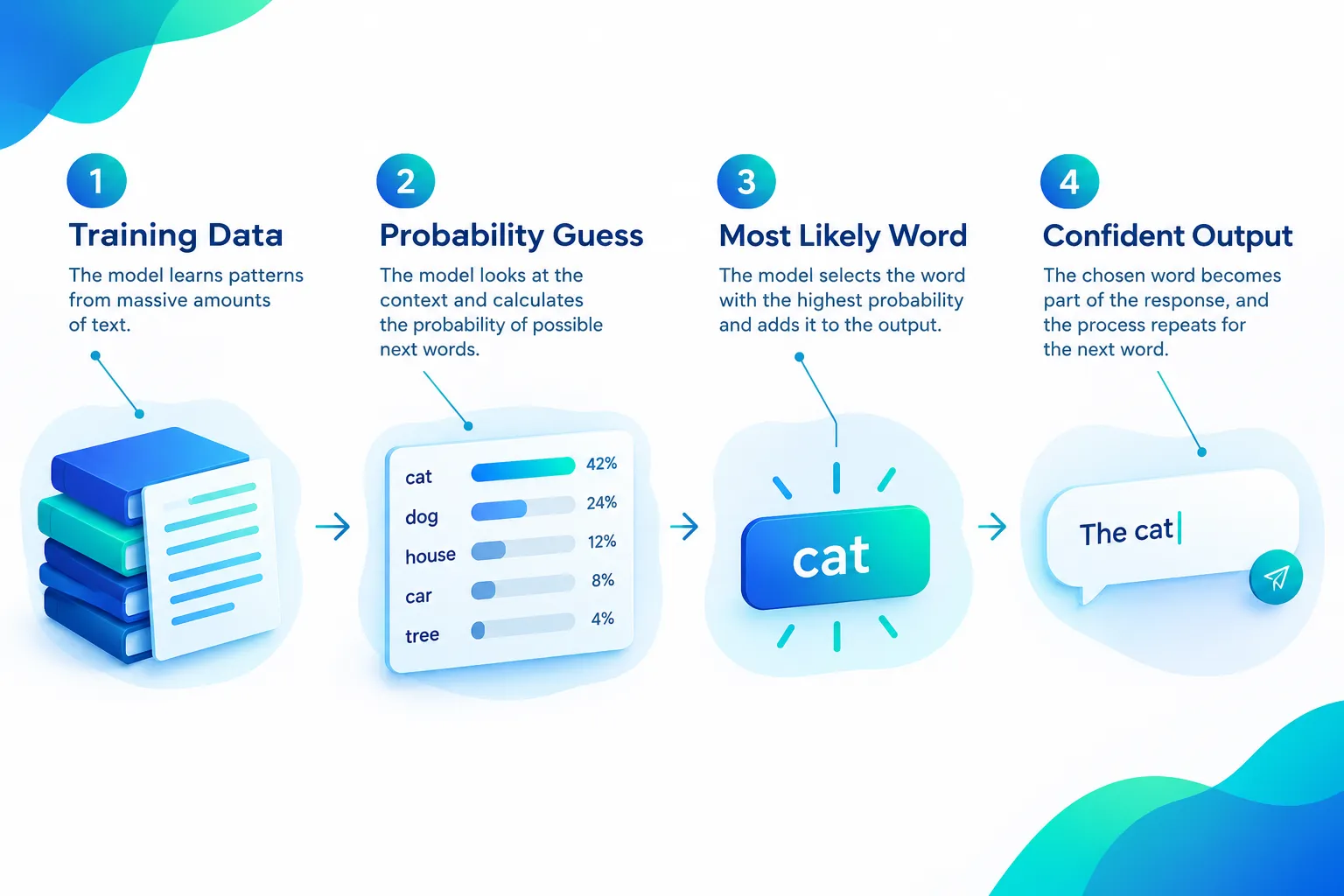
This matters for everyday work because the failure mode is invisible by default. A hallucinated court citation reads exactly like a real one. A fabricated statistic in a market report looks identical to a sourced figure. The tool gives no visual signal that it is guessing, which is why catching hallucinations requires a deliberate process rather than a gut check. For a broader look at where AI tools commonly go wrong, the AI Troubleshooting section covers related failure patterns beyond hallucination specifically.
Why AI Hallucinations Are Mathematically Inevitable, Not Just Bugs
This is the part that surprises a lot of people: hallucinations are not purely a training-data problem that better data will eventually solve. Researchers studying the mathematics behind language model prediction have shown that some rate of hallucination is a built-in consequence of how these models are trained and evaluated. Models are optimized to produce fluent, confident-sounding answers, and that optimization target rewards guessing over admitting uncertainty.
Put simply, a model that says “I don’t know” scores worse on most training benchmarks than a model that guesses and happens to be right some of the time. That incentive structure pushes systems toward confident fabrication rather than honest hedging. Industry researchers increasingly describe this as something that must be bounded and managed, not eliminated, a shift in framing from “fixing” hallucinations to containing their blast radius.

This reframing matters for anyone choosing between tools. A newer, larger model is not automatically a safer one. Some benchmarks comparing 2024 model generations against 2026 generations have actually shown hallucination rates holding steady or rising in certain tasks, particularly those involving long, complex reasoning chains or sparse source material. Bigger and more capable does not always mean more honest. If you’re comparing specific assistants for everyday use, the ChatGPT vs Claude vs Gemini comparison walks through practical tradeoffs rather than ranking one as universally best.
Real-World Stakes: From Court Sanctions to Near-Miss Operations
The consequences of unchecked AI hallucinations have moved well past embarrassing chatbot screenshots. Legal researchers tracking court filings have documented over 2,000 cases between 2023 and September 2026 where judges flagged AI-generated errors, fake precedents, invented quotes, or misstated rulings submitted by attorneys who did not verify the output before filing. Several of those incidents resulted in sanctions, fee penalties, or mandatory disclosure rules now in place at some courts.
Outside the legal world, a reported near-miss involving a U.S. military planning tool in spring 2026 raised a different kind of alarm. According to public reporting, an AI system used in an operational review process generated details that did not match verified intelligence, and the discrepancy was caught before it influenced a decision, but the margin for error was described as uncomfortably thin. These are not hypothetical risks confined to research papers. They are what happens when confident, fluent AI output meets a process that assumes the output is already correct.
A short list of where hallucinations tend to cause the most damage:
- Legal research and filings, where fabricated citations can trigger sanctions
- Medical or clinical summaries, where an invented detail can shape a decision
- Financial reporting, where made-up figures look identical to sourced ones
- Operational or logistical planning, where bad data compounds downstream
- Academic and journalistic work, where fake sources damage credibility
Are Hallucination Rates Getting Worse? What the 2026 Benchmarks Show
A common assumption is that hallucination rates steadily improve with each model release. The actual picture from 2026 benchmark comparisons is more mixed. Some narrow tasks, short factual question answering with clear source documents, have improved noticeably since 2024. But tasks involving long-form synthesis, multi-step reasoning, or sparse and ambiguous source material have shown flat or even rising hallucination rates on certain evaluation sets.
Part of the explanation is that newer models are being asked to do more. As AI systems take on longer documents, multi-tool agent workflows, and open-ended research tasks, there are simply more opportunities for a single wrong inference to compound into a fully fabricated conclusion. A model that hallucinates on 2 percent of simple questions might hallucinate on a much higher share of steps inside a ten-step agent workflow, because each step carries its own error risk.
This is one reason the editorial position worth taking here is measured rather than alarmist: hallucinations are not disappearing, but they are also not universally worsening. What changed is the complexity of the tasks people now trust AI to handle, which raises the stakes even when the underlying error rate per fact stays similar. For readers exploring agent-based tools, the Agents & Automation section covers how multi-step AI workflows introduce their own verification challenges.
Structured Data Hallucinates Too: SQL, JSON, and Business Records
A persistent myth is that hallucinations are mainly a problem for essays, chat answers, and creative writing, and that structured outputs like database queries or JSON records are inherently safer because they follow a strict format. Research through 2026 shows the opposite. Structured outputs hallucinate at rates that match or exceed free-text generation, because a model can produce a perfectly formatted SQL query or JSON object that references a column, field, or record that does not actually exist.
This is particularly risky because structured output looks mechanically correct. A JSON file with valid syntax and a SQL query that runs without an error both pass a basic sanity check, yet both can be returning completely fabricated values or querying a table that was invented on the spot. Automated pipelines that trust structured AI output without a validation layer are exposed to this exact failure mode, often without anyone noticing until a downstream report looks wrong.
Teams building AI into business processes need validation steps that check structured output against the actual schema, actual database, or actual source record, not just a format check. This is one of the clearer examples of why “it looks correct” and “it is correct” are two different standards.
How to Catch AI Hallucinations: Why AI Makes Things Up and How to Catch It in Practice
Detection has become its own area of active research in 2026, moving past simple fact-checking toward systems designed specifically to flag unreliable AI output before a human ever reads it.
Graph-based detection for retrieval systems. A detection method known as TOHA, introduced in September 2026, builds a graph-based map of claims and sources inside retrieval-augmented generation (RAG) systems, the kind of setup where an AI pulls from a document library before answering. By tracing whether each generated claim connects back to an actual retrieved passage, this approach flags statements that have no supporting source, even when the writing sounds confident and well-cited.
Uncertainty estimation. A separate research direction uses quantum-inspired uncertainty estimation techniques, explored through September and October 2026, to teach models to signal when they are extrapolating rather than retrieving known information. The goal is a model that can flag its own low-confidence answers instead of presenting every output with the same tone of certainty.
Assurance that checks the actor, not just the answer. An assurance framework discussed in industry circles in August 2026 argues that evaluating AI output in isolation misses half the picture. It proposes also evaluating “the actor”, the full pipeline, prompt history, and tool access that produced an answer, since the same model can hallucinate differently depending on what context and tools it had available at the time.
For individual users without access to specialized detection tooling, a simpler practical version of the same idea works well:
| Detection method | What it catches | Effort level |
|---|---|---|
| Ask for sources, then verify independently | Fake citations, invented statistics | Low |
| Run the same question through two different AI tools | Answers that only one model produces | Low to medium |
| Check structured output against the real schema or record | Fabricated database fields, invented JSON keys | Medium |
| Ask the model to flag its own uncertainty | Low-confidence guesses presented as fact | Low |
Practical Mitigation: Ensemble Checking and Bounded Trust
Research and practical use through 2026 point to several mitigation strategies that noticeably reduce, without fully eliminating, hallucination rates.
Ensemble cross-checking means running the same question through more than one AI system and comparing the answers. When two independent models agree on a specific fact, confidence goes up. When they diverge, that disagreement itself is a useful signal to verify manually before trusting either output. This approach has gained traction through 2026 as a low-cost way for individuals and small teams to catch hallucinations without specialized tooling.
Preference-based fine-tuning has shown strong results for narrowing hallucination rates in specific, well-defined tasks. When a model is fine-tuned on examples where human reviewers explicitly preferred accurate, source-grounded answers over fluent but unsupported ones, hallucination rates on that specific task type can drop substantially. The tradeoff is that this kind of fine-tuning is task-specific, a model tuned to reduce hallucinations in medical coding will not automatically carry that improvement into legal research or financial summaries.
Bounded trust as an operating principle. The clearest consensus among researchers heading into late 2026 is that hallucinations should be treated as a risk to be bounded, not a bug waiting for a final fix. That means building verification steps into any workflow where AI output feeds into a decision, rather than assuming a newer model version has solved the problem. This mirrors how professionals already think about other AI limitations, the same way someone evaluating ChatGPT Plus vs the free plan weighs practical tradeoffs rather than assuming a paid tier removes every limitation.
A Step-by-Step Checklist for Catching AI Hallucinations in Everyday Work
- Treat every factual claim as unverified until checked. Confidence in tone is not evidence of accuracy.
- Ask the AI to cite its source directly, then open that source and confirm the claim actually appears there.
- Run high-stakes questions through a second AI tool and compare the two answers for disagreement.
- For structured output, spreadsheets, SQL, JSON, check every referenced field or record against the real data source before using it.
- Flag long, multi-step AI tasks for extra scrutiny, since errors compound across steps in agent-style workflows.
- Keep a short internal log of past hallucinations caught in your specific use case, so patterns become visible over time.
This kind of workflow is essentially what distinguishes researched AI output from hands-on verified output, and it’s a habit worth building into any recurring use of AI for client work, research, or reporting. Browsing the Practical AI section offers more workflow-level guidance for building these checks into daily tasks, and the Research & Documents section covers verification practices specific to document-heavy work.
Frequently Asked Questions
Is an AI hallucination the same thing as a software bug? No. A bug is a flaw that can usually be patched. A hallucination is a side effect of how language models predict text, and research through 2026 suggests some rate of it is mathematically built into the training process itself, not something a single update removes entirely.
Do more expensive or newer AI plans hallucinate less? Not reliably. Some premium models reduce hallucinations on certain tasks, but 2026 benchmark data shows rates holding steady or rising on others, especially long or complex reasoning tasks. Plan tier is not a dependable proxy for factual accuracy, so verification still matters regardless of which AI tools and plans you use.
Why do AI-generated spreadsheets and database queries hallucinate if they’re just following a structured format? Following a format correctly does not guarantee the content inside it is accurate. A SQL query can run without error while referencing a table or field the model invented. Structured output needs the same verification as plain text, sometimes more, since formatting errors are easier to catch than data errors.
What is the single most effective way to catch a hallucination without specialized tools? Ask for a direct source for any specific fact, date, statistic, or citation, then check that source yourself. If the AI cannot produce a real, checkable source, treat the claim as unverified until confirmed elsewhere.
Are hallucination rates actually getting worse in 2026? It depends on the task. Simple factual question-answering has generally improved since 2024. Long-form synthesis and multi-step agent tasks have shown flat or rising hallucination rates on some benchmarks, largely because these tasks give errors more chances to compound.
Conclusion
AI hallucinations are not a temporary flaw that the next model update will quietly fix. They are a structural feature of how these systems generate language, and the practical response is verification, not blind trust. Understanding AI Hallucinations Explained: Why AI Makes Things Up and How to Catch It means accepting that confident, well-formatted answers can still be wrong, in a chat response, a court filing, a database query, or a planning document.
The next step is building verification into everyday work: ask for sources and check them, cross-reference answers across tools, treat structured output with the same skepticism as plain text, and flag long multi-step AI tasks for closer review. None of this requires technical expertise, just a consistent habit. For more practical guidance on using AI tools without the hype, the Tech Clearly blog covers testing, comparisons, and troubleshooting across the AI tools people actually use day to day.
Meta Title: AI Hallucinations Explained: Why AI Makes Things Up
Meta Description: AI Hallucinations Explained: learn why AI invents facts, why it’s structural not a bug, and practical steps to catch errors before they cause harm.
Tags: AI hallucinations, generative AI errors, AI fact-checking, large language models, RAG systems, AI reliability, hallucination detection, AI troubleshooting, machine learning limitations, structured data errors, AI mitigation strategies, responsible AI use
Contributing writer at Tech Clearly.