

How AI Plan Pricing Works: Tokens, Tiers, and Usage Limits Explained
A single AI chat message can quietly cost a business anywhere from a fraction of a cent to several dollars, depending on which model answered it and how long the reply ran. Most people never see that math happen. They just see a monthly subscription fee or a “limit reached” message. Understanding how AI plan pricing works, tokens, tiers, and usage limits explained in plain terms, is the difference between picking a plan that fits your actual work and overpaying for capacity you never use.
This matters more in 2026 than it did even a year ago. Providers like OpenAI, Anthropic, and Google have all adjusted pricing, introduced new rate-limit tiers, and rolled promotional pricing into permanent pricing during the past several months. If you’re choosing between a consumer subscription and a developer API plan, or trying to figure out why your team suddenly hit a usage cap, the mechanics below explain what actually matters.
Key Takeaways
- AI pricing splits into two different systems: flat monthly subscriptions for chat apps, and per-token metered billing for API access, and they are rarely interchangeable.
- A “token” is a small chunk of text, roughly three-quarters of a word on average, and providers charge separately for input tokens (what you send) and output tokens (what the AI generates).
- Usage limits aren’t just about token counts, providers also cap requests per minute, requests per day, and even spending per ten-minute window, especially on API plans.
- Pricing changes on a real schedule. Google has announced a Gemini 3 token price increase effective December 1, 2026, and Anthropic has both cut and stabilized prices on different models during 2026.
- The right plan depends on your pattern of use, not the sticker price, occasional chat users usually want a subscription, while developers and automation workflows usually need to model token costs directly.
How AI Plan Pricing Works: The Two Billing Systems You’ll Actually Encounter
Before comparing numbers, it helps to separate two pricing worlds that often get confused.
The first is subscription pricing, the kind most people meet first. ChatGPT’s paid tiers, Go, Plus, Business, and Enterprise, are priced per user per month, with monthly billing available on Go, Plus, and Business, and annual billing options for Business and Enterprise. You pay one predictable fee, and the chat interface absorbs the token costs behind the scenes, usually within a daily or monthly message cap rather than a literal token count you can see.
The second is API pricing, which is metered. If you build an app, automate a workflow, or connect an AI model through a tool rather than a chat window, you are billed per token, separately from any ChatGPT subscription. OpenAI is explicit that API usage is not covered by ChatGPT Plus, Business, Enterprise, or Edu subscriptions, they are billed independently. This confuses a lot of small-business users who assume their $20-a-month chat subscription also covers their automation project. It does not.
Anthropic’s Claude plans sit in between these two models. Claude offers seat-based subscription tiers, a lower-cost plan around $17 per month (with an annual option billed upfront near $200) and a higher tier around $100 per month aimed at all-day work, but usage within those plans is still metered by prompt tokens. Prompts under 100,000 tokens are priced at a much lower per-million-token rate than prompts that exceed that threshold, which creates a real cost jump once a single prompt crosses that line. That’s an important design detail: your subscription tier doesn’t eliminate token-based tradeoffs, it just changes where they sit.
If you’re deciding between a consumer plan and a developer plan for the same AI family, our ChatGPT Plus vs Free comparison and the broader AI Tools & Plans category are good places to check current plan details before committing.
What a Token Actually Is, and Why It Drives the Price
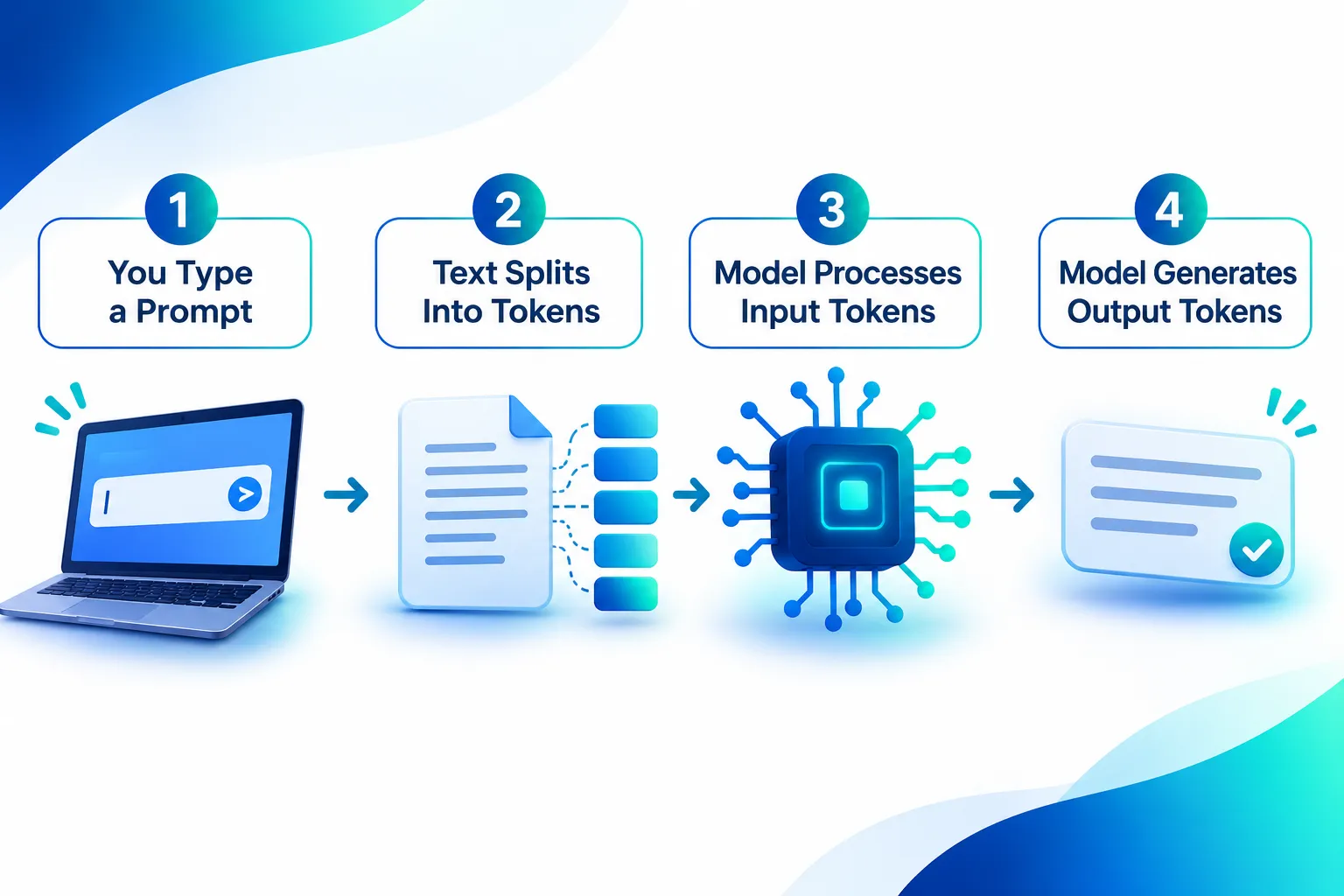
A token is a fragment of text, sometimes a whole word, sometimes a few characters, sometimes just punctuation. On average, one token works out to roughly three-quarters of an English word. When you send a prompt, the AI model converts your text into a sequence of tokens, processes them, and then generates a new sequence of tokens as its answer.
This matters because providers charge input tokens and output tokens at different rates, almost always with output tokens costing more. Google’s Gemini API pricing documentation spells this out directly: billing is based on input token count, output token count (including internal “thinking tokens” used for complex reasoning), cached token count, and even how long cached tokens are stored.
Here’s a concrete, researched example of how dramatically rates can shift across models and time. One Gemini 3 configuration is priced at $2.00 per million input tokens through November 30, 2026, rising to $4.00 per million starting December 1, 2026, with output tokens scheduled to jump from $10.00 to $20.00 per million on the same date. That’s a scheduled, announced price increase, not a hypothetical one, and it illustrates something easy to miss: the price you lock in today for a given model is not guaranteed to hold next quarter.
Anthropic has moved in the opposite direction on some models. Claude Sonnet 5 launched with introductory pricing of $2 per million input tokens and $10 per million output tokens, originally framed as temporary through August 31, 2026. Anthropic has since made that rate permanent rather than letting it expire higher, showing that promotional pricing doesn’t always end in a price hike, sometimes competitive pressure keeps it in place.
A useful way to think about this: tokens are the meter, and the per-token rate is the price per unit on that meter. Longer conversations, longer documents, and longer generated answers all use more units, which is why summarizing a 40-page report costs meaningfully more than asking a one-line question. If you regularly process long files, our guide on how to summarize long documents with AI without losing key details covers practical ways to control token usage while still getting complete results.
How AI Plan Pricing Works Across Tiers: What Changes as You Move Up
Tiers typically unlock three things: access to stronger models, higher usage ceilings, and additional features like larger context windows or grounding tools (search, maps, and similar add-ons).
A practical comparison of what tier upgrades usually buy you:
| What changes | Lower tier | Higher tier |
|---|---|---|
| Model access | Entry or “fast” models only | Access to flagship reasoning models |
| Usage ceiling | Lower daily or monthly caps | Higher caps, sometimes near-unlimited for typical use |
| Context window | Smaller, shorter documents only | Larger, handles long documents or codebases |
| Extra features | Basic chat only | Grounding (search/maps), priority processing, team seats |
| Support | Standard | Priority or dedicated support on business/enterprise tiers |
Grounding features are a good example of tier-dependent costs that aren’t obvious up front. Gemini’s grounding with Google Search is free up to 500 requests per day, sharing that quota with other Flash-tier limits, and then billed at $35 per 1,000 grounded prompts once you exceed it. Google Maps grounding has its own separate free quota and overage rate, and newer Gemini 3-era models instead offer a shared monthly allotment of free search queries before charges begin. None of this shows up unless you read the fine print on a provider’s pricing page, which is exactly why checking last verified pricing before building a workflow around a specific feature matters.
For a broader sense of how different AI assistants are positioned for different kinds of work, not just price, but actual fit, see our comparison of ChatGPT, Claude, and Gemini.
Usage Limits: The Caps That Matter Beyond Price
Even if you’re happy to pay for more tokens, providers still cap how fast and how often you can use them. These limits exist to protect infrastructure, not just to upsell you, but they directly affect what you can build or automate.
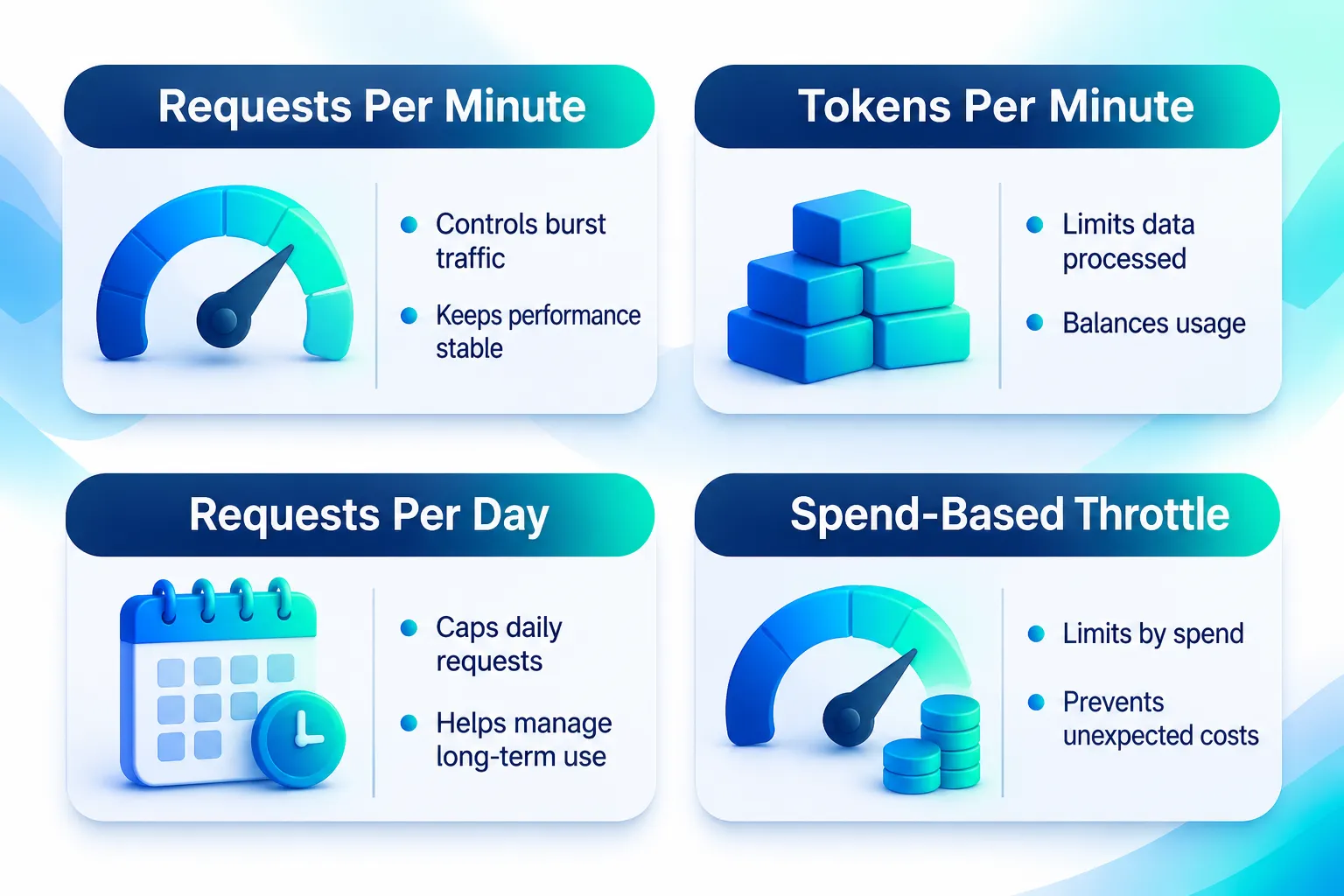
The main limit types you’ll run into:
- Requests per minute (RPM): how many separate API calls you can make in a 60-second window.
- Tokens per minute (TPM): the total token volume, input plus output, you can process per minute, applied per project rather than per individual key.
- Requests per day (RPD): a daily ceiling, often the first limit casual users or small apps actually hit.
- Spend-based throttles: a rolling-window cap on dollars spent, independent of raw token counts.
Google’s Gemini rate-limit system is a clear, researched example of spend-based throttling layered on top of token limits. Usage tiers are unlocked based on account verification and payment history: an entry tier requires only a linked billing account and allows a modest spend rate over a rolling 10-minute window; a middle tier requires having paid at least $100 and waiting three days since the first successful payment; and a top tier requires $1,000 in payments and 30 days of history, which unlocks monthly spend ranges stretching into the tens of thousands of dollars. In other words, your usage ceiling isn’t fixed by your plan name alone, it grows as your account builds a payment history.
This tiered-trust model is becoming more common across providers, and it’s one reason a new account testing an API for the first time may hit limits that feel surprisingly low compared to what the pricing page implies is possible. If you’re automating repeated AI tasks, it’s worth reading up on what an AI agent actually is before scaling a workflow that could quietly run into both token costs and rate limits at once.
Practical Tradeoffs: Matching a Plan to How You Actually Work
There isn’t a universally “best” plan, there’s a best fit for your usage pattern. A few practical scenarios:
Occasional personal use (writing help, research, brainstorming). A flat-rate subscription like ChatGPT Plus or a comparable Claude tier is almost always the simpler and cheaper choice. You get predictable monthly cost and don’t need to think about tokens at all.
Small business or freelance workflows with moderate automation. This is where the subscription-versus-API line matters most. If you’re using a chat app manually, stick with a subscription. If you’re piping documents through an API for repeated summarization or data extraction, you need to estimate token volume, because costs scale directly with how much text you process, something our piece on summarizing long documents without losing key details addresses from the output-quality side.
Developers building products on top of AI models. API metering, rate limits, and tiered spend caps all apply directly. Budgeting requires modeling expected token volume per request, expected requests per day, and the gap between promotional and standard pricing, since, as the Gemini 3 and Claude Sonnet 5 examples show, rates can move in either direction after a defined date.
Enterprise and team deployments. Negotiated discounts, annual billing, and dedicated support typically come into play, along with firmer service-level expectations. These arrangements are usually customized, so published list prices function more as a baseline than a final number.
Across all of these, one point holds steady: low list prices on a pricing page do not guarantee low real-world cost, and generous-sounding “unlimited” messaging in a subscription plan often still hides a daily cap once you dig into terms of service.
What Actually Matters When You’re Comparing Plans
When evaluating any AI pricing page, a short checklist helps cut through marketing language:
- Is this subscription pricing or token-metered API pricing? They are not the same product.
- What’s the input versus output token rate? Output is almost always more expensive, and long generated answers add up fast.
- Is there a threshold where pricing jumps? Some plans, like Claude’s 100K-token prompt boundary, charge a much higher rate once you cross a line.
- Are there rate limits separate from cost? Requests per minute and per day can block you well before you hit a spending cap.
- Is the current price promotional? Check whether a listed rate has an expiration date attached, since several providers have let promotional token pricing lapse into standard pricing, while others have scheduled increases.
- When was this pricing last verified? Provider pricing pages change without much warning, so treat any number you read, including the ones in this article, as accurate as of the stated research date rather than permanent.
For ongoing coverage of how specific providers adjust their plans, the AI & Tech Updates category and AI Comparisons category track changes as they’re confirmed.
Where AI Pricing Seems to Be Headed
This next part is a reasoned expectation based on recent patterns, not a confirmed roadmap. Anthropic cut list prices on standard models between mid and late 2026, while Google has scheduled a token price increase on Gemini 3 for December 2026. Taken together with increasingly detailed spend-based rate tiers, this suggests providers are actively experimenting with pricing rather than settling on a stable structure. Over the next year or two, it seems reasonable to expect more volume discounts for high-usage customers, pricing that bundles grounding or search quotas into core plans, and broader use of abstracted “compute unit” billing similar to Anthropic’s CCU conversion model. None of that is announced yet, it’s a pattern-based expectation, not a guarantee, and worth revisiting as providers publish updated pricing.
FAQ
Does my ChatGPT Plus subscription cover API usage for my own app? No. OpenAI bills API usage separately per token, and that cost is not included in ChatGPT Plus, Business, Enterprise, or Edu subscriptions.
Why did my AI assistant stop responding even though I haven’t used many tokens? You may have hit a rate limit rather than a token limit, requests per minute or requests per day caps can trigger before you reach a spending or token ceiling, especially on newer or unverified accounts.
Are longer prompts always proportionally more expensive? Mostly yes, but watch for threshold pricing. Some plans, like certain Claude tiers, charge a flat per-token rate up to a point and then a much higher rate once a prompt exceeds a set token count.
Is promotional AI pricing guaranteed to increase later? Not always. Claude Sonnet 5’s introductory per-token rate was made permanent rather than raised, while Google has announced a scheduled increase for certain Gemini 3 token prices in December 2026. Check the specific model’s terms.
How do I estimate API costs before building a project? Estimate expected input and output token volume per request, multiply by the published per-million-token rate for your chosen model, and factor in rate limits that might slow a high-volume workflow regardless of budget.
Is a subscription or an API plan better for a small business? It depends on the task. Manual chat-based work usually fits a subscription better; repeated, automated, or high-volume text processing usually needs API pricing because it scales with actual usage rather than a flat fee.
Conclusion
AI pricing looks confusing mainly because providers are running two different billing systems at once, flat subscriptions for everyday chat use, and metered token pricing for automated or developer-driven work, while also layering on rate limits and spend-based throttles that have nothing to do with the sticker price. The practical next step is to match your actual usage pattern to the right system: if you’re chatting occasionally, a subscription is simpler and usually cheaper; if you’re building or automating, model your expected token volume and rate-limit exposure before you commit. Pricing details shift often enough that it’s worth rechecking a provider’s current page before making a plan decision, and treating any published rate as current only as of its last verified date. For ongoing, practical guidance on choosing and comparing AI plans as pricing evolves, the Practical AI section and AI Troubleshooting category are useful places to check back.
Meta Title: How AI Plan Pricing Works: Tokens, Tiers, and Limits
Meta Description: A clear breakdown of how AI plan pricing works, tokens, tiers, and usage limits explained, with practical guidance for choosing the right plan in 2026.
ai pricing, token pricing, AI subscription plans, API pricing, usage limits, ChatGPT pricing, Claude pricing, Gemini pricing, AI tiers, rate limits, AI cost comparison, enterprise AI plans
Contributing writer at Tech Clearly.