

How to Verify AI Research, Sources, and Citations
A university librarian in 2026 can now spot a fabricated citation in under thirty seconds using free tools that did not exist two years ago. That speed matters, because AI chatbots still invent sources with total confidence, fake journal names, real-sounding authors, and page numbers that lead nowhere. Knowing how to verify AI research, sources, and citations is no longer a niche academic skill. It is a basic professional habit, the same way checking a contract’s fine print became routine once people started signing things online.
This guide breaks down what actually matters when you ask an AI tool for research help, where the risks hide, and the exact steps to confirm a source before you quote it, cite it, or hand it to a client, professor, or boss.
Key Takeaways
- AI tools can generate citations that look completely real but point to sources that do not exist, always confirm before using them.
- The fastest check is opening the actual link or searching the exact title, author, and publication name independently.
- Specialized hallucination-detection tools now score how well an AI answer is “grounded” in real source material, but they are an aid, not a replacement for human review.
- Universities and research institutions now require explicit verification of AI-assisted citations as part of their 2026 academic integrity policies.
- Treat AI as a drafting assistant, disclose when you used it, and keep citation-checking separate from that disclosure step.
Why AI Research Needs Verification Now
Large language models are built to predict plausible-sounding text, not to guarantee factual accuracy. When a model does not have a real source handy, it can still generate one that reads exactly like a legitimate citation, complete with a journal name, a volume number, and a confident tone. This is commonly called a hallucination, and it happens even in the newest, most capable models released in 2026.
The problem has gotten enough attention that it changed institutional policy. University writing centers and library research-support services now explicitly require students and staff to verify any AI-generated reference against an authoritative source before submission. Library guidance published in late summer 2026 pushed this further, recommending that researchers treat every AI-suggested citation as unverified until checked independently, the same way a fact-checker treats an anonymous tip.
This is not about distrusting AI outright. Tools like ChatGPT, Claude, Gemini, and Grok are genuinely useful for summarizing, outlining, and pointing you toward concepts worth researching further. For a side-by-side look at how these tools differ in everyday work, see this comparison of ChatGPT, Claude, and Gemini. The issue is narrower: the specific step where an AI tool names a source, a quote, or a statistic. That step needs a human check, every time.
A citation that looks correct and a citation that is correct are two different things, and AI models are very good at producing the first one.
How to Verify AI Research, Sources, and Citations Step by Step
Verifying AI output does not require a research degree. It requires a consistent routine, applied every time an AI tool gives you a fact, quote, or reference you plan to use publicly.
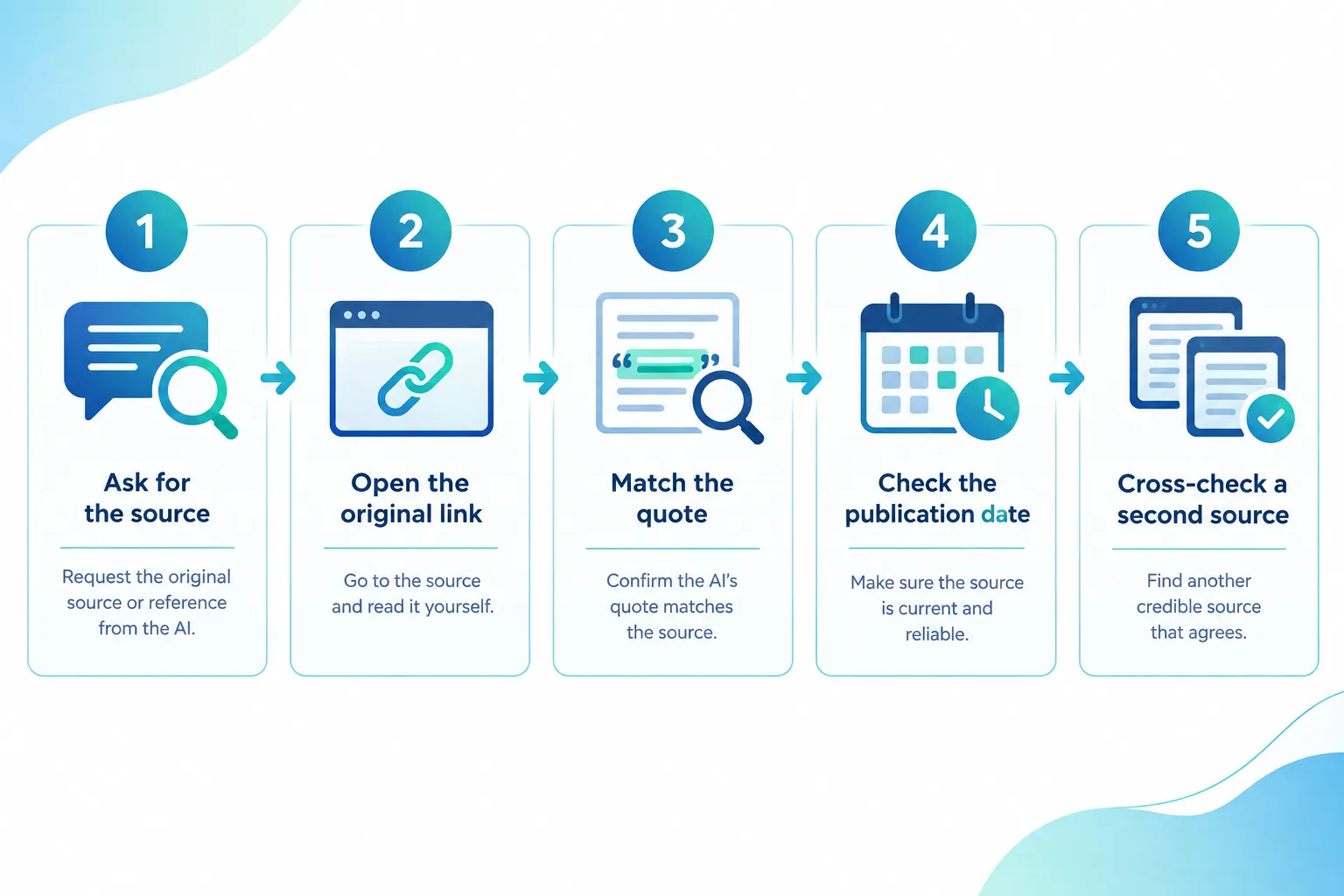
Step 1: Ask the AI tool to show its source directly
Prompt the model to name the exact publication, author, date, and a direct quote it is drawing from. If it cannot produce a specific, checkable source, treat the claim as unsupported rather than simply unverified.
Step 2: Search for the source independently
Open a search engine or a dedicated database (Google Scholar, PubMed, JSTOR, or a relevant industry archive) and search the exact title and author name the AI provided. If nothing matches, or the closest match has a different title, author, or year, the citation is likely fabricated.
Step 3: Open the actual link and read the passage
If a URL is provided, click through. Confirm the page exists, is not a dead link or a generic homepage, and actually contains the claim or quote attributed to it. AI tools sometimes attach a real, working URL to the wrong claim, a subtler error than a fake link entirely.
Step 4: Match the quote word for word
If the AI output includes a direct quote, search for a unique phrase from it in quotation marks. A genuine quote will usually surface the original document. A fabricated one often returns nothing, or returns a different source saying something similar but not identical.
Step 5: Cross-check with a second independent source
Single-source claims, even verified ones, deserve a second opinion, especially for statistics, medical information, or legal claims. This mirrors how working journalists and editors confirm facts before publishing, and it is standard practice described in Tech Clearly’s editorial standards.
Step 6: Check the publication date
AI training data has a cutoff, and models sometimes present outdated information as current. Confirm the source’s actual publish or last-updated date, particularly for anything involving pricing, software features, or regulations that change frequently.
This six-step routine takes a few minutes per claim, but it is the difference between citing real research and quietly repeating something an AI tool invented.
Concrete Techniques Researchers Use to Catch Fake Citations
Beyond manual checking, researchers and AI engineers have developed more systematic methods worth knowing about, even if you never build these tools yourself.
Sentence-level claim checking breaks an AI-generated answer into individual factual statements and checks each one against a retrieved source document, rather than judging the whole answer at once. This catches cases where one sentence in an otherwise accurate paragraph is unsupported.
“Cheap” dictionary checks, a technique that gained attention in research published around September 2026, compares named entities, author names, journal titles, organization names, against known databases to quickly flag anything that does not exist. It is not perfect, but it is fast and catches a meaningful share of outright fabrications.
Multi-sample polling asks the same question to an AI model several times with slightly different phrasing. If the model gives a consistent, specific source every time, that is a modest signal of reliability. If the source changes each time, that is a strong signal it is being invented on the spot.
Groundedness scoring, used in hallucination-detection systems that matured through mid-2026, measures how directly an AI’s answer is supported by the actual source material it was given, rather than by its general training. This is the technical foundation behind many of the “faithfulness” scores used in retrieval-augmented generation (RAG) systems, AI setups that are supposed to answer only from a specific, provided document set.
None of these techniques replace a human reading the actual source. They reduce how often a human needs to.
Tools That Help Verify AI Research, Sources, and Citations
A small but growing set of tools now exists specifically to catch hallucinated or suspicious citations. The landscape in 2026 includes open-source libraries, commercial platforms built into enterprise AI products, and self-hosted options for organizations with stricter data requirements.
| Tool Category | What It Does | Best Fit |
|---|---|---|
| Hallucination-detection APIs | Score an AI answer’s groundedness against supplied source text | Developers building AI products |
| Citation-checking browser extensions | Flag broken links or mismatched metadata on pasted citations | Students, writers, researchers |
| RAG faithfulness evaluators | Measure whether a chatbot’s answer actually matches its retrieved documents | Companies running internal AI search tools |
| Reference-manager plugins | Cross-check citation formatting and source existence against academic databases | Academic and scientific writing |
| Manual verification checklists | Structured human review steps, often provided by university libraries | Anyone without access to paid tools |
Most individual professionals will get the most value from the simplest category: manual verification checklists combined with a search engine and a reference database. The more automated tools matter most for teams building AI-powered research assistants, chatbots, or internal knowledge tools, a category covered in more depth in Tech Clearly’s agents and automation coverage.
It is worth being direct about a limitation here: this article describes these tools based on researched information about the 2026 verification tooling landscape, not hands-on testing of each specific product. Capabilities, pricing, and accuracy rates for commercial hallucination-detection tools change often, so confirm current performance claims directly with the vendor before relying on a tool for high-stakes work.
Common AI Citation Problems and How to Catch Them
Not every AI sourcing error looks the same. Recognizing the pattern helps you check faster.
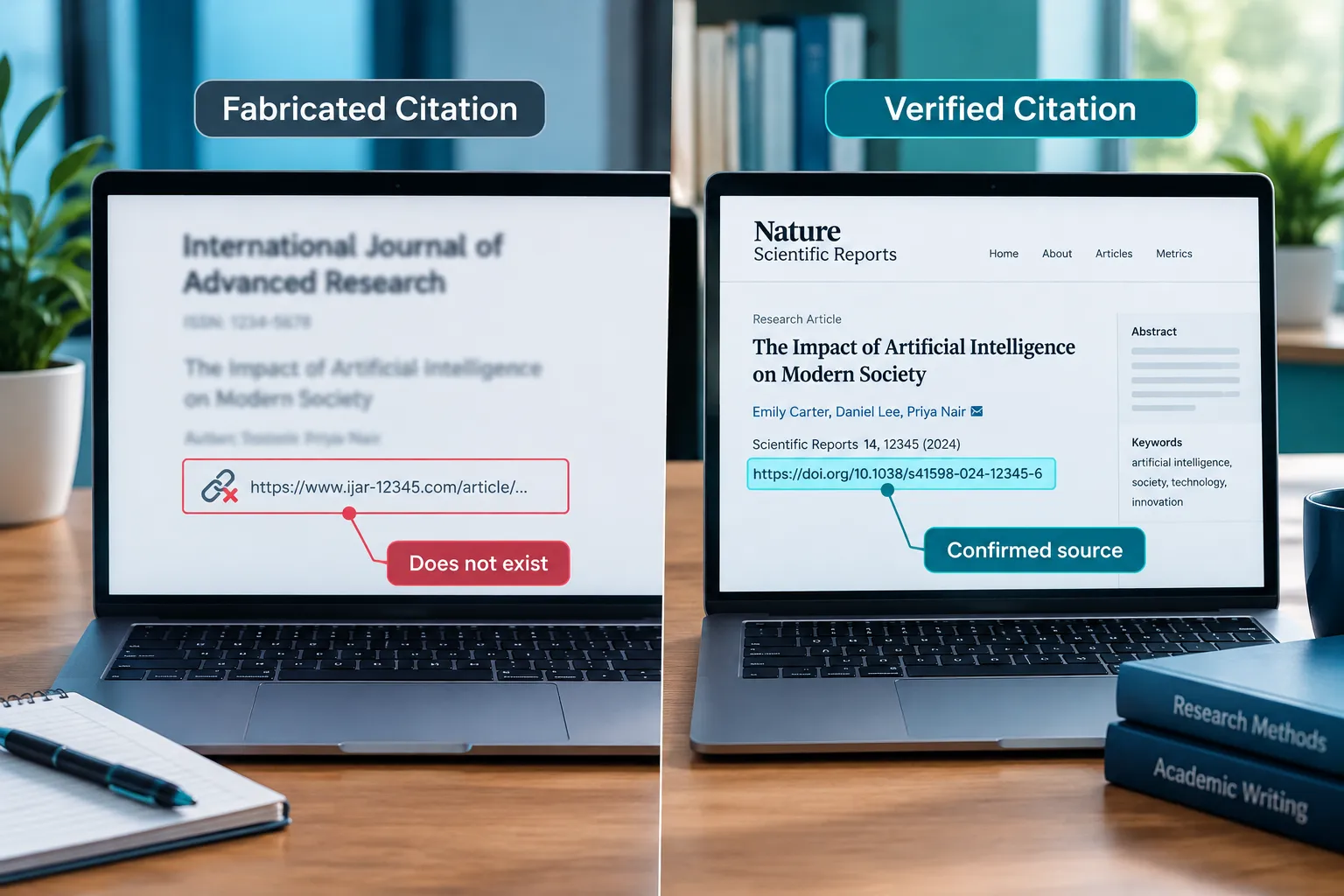
- The fully invented source. A journal, author, and title that sound plausible but return zero search results. This is the easiest to catch, a quick search usually reveals nothing matches.
- The real source, wrong claim. A legitimate, working link attached to a statement the source never actually makes. This requires reading past the headline or abstract.
- The outdated source presented as current. A real article from several years ago, cited as if it reflects the current state of a fast-changing topic like AI pricing or model capabilities.
- The merged source. Details from two different real sources blended into one citation, a real author’s name paired with a different paper’s title, for example.
- The paraphrase mistaken for a quote. Text presented in quotation marks that is actually the AI’s summary, not an exact quote from the original.
This same unreliability pattern shows up broadly across AI chatbot behavior, not just in citations. For a fuller breakdown of why models fabricate information in the first place, see Tech Clearly’s explainer on AI hallucinations.
Best Practices for Verifying AI Research, Sources, and Citations in Everyday Work
The most reliable approach treats AI the way a careful editor treats a junior researcher: useful for a first pass, but never the final word on a fact.
- Treat AI output as a draft, not a finished answer. Use it to generate leads and structure, then verify anything specific before it goes into a report, article, or academic paper.
- Disclose AI use separately from citation checking. Many workplaces and universities now expect a disclosure statement when AI tools were used in research or drafting. That disclosure does not replace verifying the sources, the two are separate obligations.
- Keep a verification log for important work. For research projects, client deliverables, or published content, note which claims were checked, against what source, and when. This habit protects you if a claim is later questioned.
- Prioritize checking for high-stakes claims. Medical, legal, financial, and statistical claims deserve the most scrutiny. A wrong date in a casual blog post is a minor error; a wrong statistic in a client report or academic paper is a credibility problem.
- Note when you last verified something. Pricing, product features, and AI model capabilities change constantly. Stating when a fact was last verified, even informally, like “confirmed November 2026”, gives readers and colleagues useful context about how current the information is.
These habits apply well beyond research writing. Anyone using AI tools for day-to-day work can find more general guidance in Tech Clearly’s practical AI coverage and in the productivity and workflows category, both of which cover how to integrate AI responsibly into regular tasks.
What to Do When You Cannot Verify a Source
Sometimes a citation simply cannot be confirmed, even after a reasonable search. In that case, the correct move is to drop the claim entirely or rewrite it without the specific attribution, rather than publishing something unverified and hoping it holds up. If the underlying idea seems reasonable but the specific source does not check out, search independently for a real source that supports the same point. If nothing supports it, the claim likely does not belong in serious work.
For organizations building AI-assisted research tools internally, this is also where layered prevention matters. Production systems in 2026 increasingly combine several safeguards at once: grounding answers in a verified document set, running contextual checks on claims before they reach a user, and applying evaluation frameworks that score answers before they are shown. No single layer catches everything, which is why multiple checks stacked together perform better than any one method alone. Teams dealing with AI tools that misbehave or produce inconsistent results may also find it useful to browse Tech Clearly’s AI troubleshooting resources for related diagnostic approaches.
Looking ahead, analysts following this space expect citation verification to become a built-in feature of mainstream AI assistants rather than a separate add-on tool, with more models showing confidence scores or direct source links by default. Until that becomes standard across every major tool, the manual verification habits in this guide remain the most dependable safeguard.
Frequently Asked Questions
Can AI tools cite real sources accurately at all? Yes, often. Many AI tools correctly cite real, existing sources, especially when using retrieval-augmented generation that pulls from a defined document set. The risk is inconsistency, the same tool can be accurate in one answer and fabricate a source in the next, which is why every citation still needs an independent check.
Is it safe to trust citations from AI tools with live web search? Tools with live web search access tend to produce more accurate citations than those relying only on training data, because they can link to a real, current page. Still verify the link actually supports the claim, since mismatched attribution can happen even with real sources.
How do I verify an AI citation if I do not have access to academic databases? A standard search engine, Google Scholar, or the publisher’s own website is usually enough to confirm whether a title, author, and publication exist. For paywalled academic sources, checking the abstract or summary page is often sufficient to confirm the source is real, even without full access.
What should I do if my professor or employer requires AI disclosure? Follow their specific policy for disclosure wording and format. Keep that disclosure separate from your citation verification process, disclosing AI use does not excuse unverified facts, and verifying facts does not remove the need to disclose AI assistance where required.
Are hallucination-detection tools reliable enough to skip manual checking? Not yet, based on current researched information about these tools in 2026. They are useful for flagging likely problems at scale, particularly in production AI systems, but they are not a substitute for a human confirming a specific, important source before it is published or submitted.
Conclusion
AI tools are genuinely useful for research, for outlining, summarizing, and surfacing ideas worth exploring further. What they cannot be trusted to do, on their own, is confirm that a source actually exists or says what the AI claims it says. Knowing how to verify AI research, sources, and citations comes down to a short, repeatable routine: ask for the specific source, search for it independently, open the actual link, match quotes word for word, and cross-check anything important with a second source.
Build that routine into everyday work, whether that is a student paper, a client report, or a blog post, and the risk of publishing a fabricated fact drops sharply. For more on how AI tools behave, where they fall short, and how to use them well across daily tasks, browse Tech Clearly’s research and documents coverage and the broader AI tools and plans category for current, practical guidance.
Meta Title: How to Verify AI Research, Sources, and Citations (2026)
Meta Description: Practical, step-by-step guidance on how to verify AI research, sources, and citations before you publish, submit, or trust what a chatbot tells you.
AI research verification, AI citations, fact-checking AI, AI hallucinations, source verification, academic integrity AI, RAG faithfulness, citation checking tools, AI fact checking, research tools 2026, AI accuracy, groundedness scoring
Contributing writer at Tech Clearly.