

The Tech Clearly Editorial Team publishes practical, research-based guidance on AI and modern technology, with an emphasis on clear comparisons, current information, troubleshooting, and transparent sourcing.
What Is Grok AI and What Can It Do? A Practical Guide for 2026
xAI released a model in August 2026 that ties GPT-5.6 Sol on a major independent intelligence benchmark and beats it on a well-regarded coding test, and most people who use AI chatbots every day have still never opened the Grok app. That gap between capability and awareness is exactly why this guide exists. If someone asked what is Grok AI and what can it do, the short answer used to be “a chatbot built by Elon Musk’s company.” In 2026, that answer is out of date.
Grok has grown from a text-based chatbot into a multimodal system that writes, codes, sees images, talks out loud, generates video, and, as of Grok Bot, can run multi-step tasks on its own inside a team’s existing software. This article breaks down what Grok actually is, what it can realistically do for everyday work, and where it still has limits worth knowing before switching from a tool that’s already working.
Key Takeaways
- Grok AI is a large language model built by xAI that answers questions, writes and debugs code, summarizes documents, and pulls real-time information from the web and the X platform.
- Grok’s multimodal features now include voice conversation, image and document understanding, and Grok Vision, which reads real-world text and objects through a phone camera.
- Grok Imagine adds image and short-video generation, turning Grok from a chat tool into a broader creative suite.
- Grok 4.6, released August 12, 2026, is xAI’s current flagship model, with benchmark results that put it in the same tier as leading models from other major AI labs.
- Grok Bot introduces autonomous AI agents that can operate software directly and keep working on tasks after a person logs off, though access is currently limited to higher-tier plans.
What Is Grok AI and What Can It Do? A Quick Definition
Grok AI is a generative conversational chatbot built by xAI, the artificial intelligence company founded by Elon Musk. It first launched in November 2023 as a large language model designed to generate, transform, and analyze text. At its core, Grok works the same way most modern AI chatbots do: a person types or speaks a question, and the model produces a response drawn from patterns it learned during training, combined with information it can retrieve in real time.
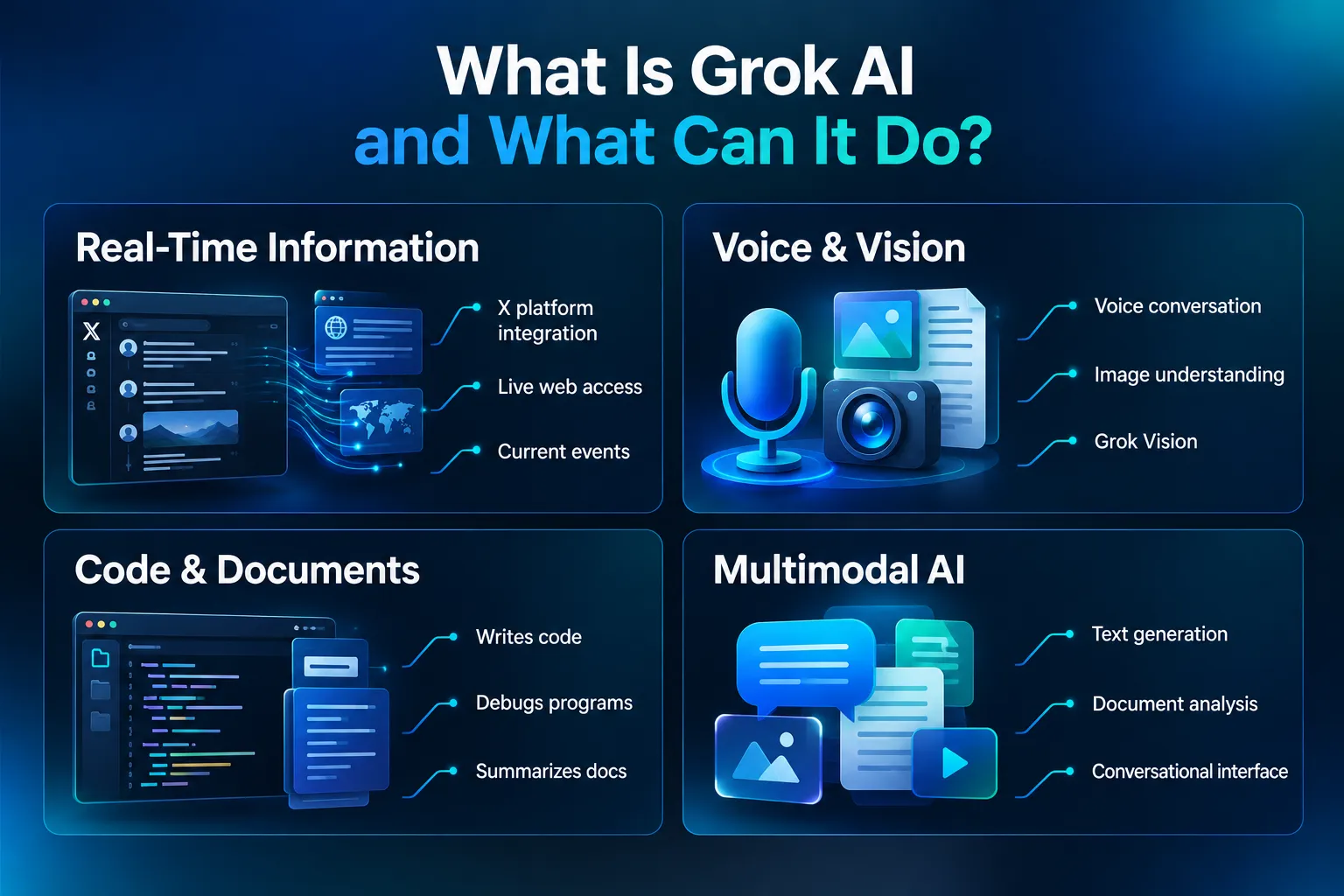
What sets Grok apart from many static language models is its connection to live data. Grok can search the current web and pull information from X (formerly Twitter), which means it can discuss recent events, trending topics, or fast-moving news without the built-in delay that affects models trained only on a fixed dataset. That real-time layer is one of the clearest answers to what is Grok AI and what can it do differently from competitors, it isn’t limited to what it learned during training.
Grok is available as a standalone app on iOS and Android, through a web interface, and via an API that developers can build into their own products. For a broader look at how AI chatbots fit into daily work, the Practical AI category on Tech Clearly covers related tools and use cases.
What Can Grok AI Do? Core Features Explained
The practical question most people care about is simpler than the technology behind it: what can this actually help with day to day? Grok’s core capabilities fall into a few clear categories.
Everyday tasks Grok handles well:
- Answering questions and explaining concepts in plain language
- Researching topics and summarizing long articles or reports
- Solving math problems and working through step-by-step calculations
- Drafting content such as emails, outlines, and social posts
- Brainstorming ideas for projects, names, or campaigns
- Writing, explaining, and debugging code
- Automating repetitive multi-step tasks
For coding specifically, xAI has built specialized variants such as Grok 4 Code, aimed at writing, debugging, and explaining code more efficiently. Independent coverage in 2025 and 2026 has repeatedly pointed to Grok’s strong performance on programming benchmarks, positioning it as a serious option alongside dedicated coding assistants like GitHub Copilot. Freelancers and small teams evaluating AI for repetitive work may find useful context in the Productivity & Workflows section of Tech Clearly, which covers how different tools fit into real workflows.
The real-time search feature deserves a second mention because it changes how Grok behaves compared to many chatbots. Ask a static model about something that happened last week, and it may not know. Ask Grok, and it can pull current web results and recent X posts to fill that gap. This makes Grok noticeably more useful for tasks tied to current events, trending topics, or fast-changing information, though as with any AI-generated summary of live information, it’s worth double-checking anything that matters for a decision.
Grok’s Multimodal Toolkit: Voice, Vision, and Grok Imagine
A text chatbot that only reads and writes words has real limits. Grok has moved well past that. As of 2026, Grok’s multimodal features cover text, voice, and vision, turning it into something closer to an all-purpose assistant than a typing tool.
Voice Mode lets users talk to Grok out loud through the mobile app, with support for multiple languages and real-time search built into the conversation. This matters for anyone who wants to think through a problem hands-free, such as while driving or cooking, rather than typing out a full message.
Grok Vision allows the app to interpret what a phone camera sees. Point the camera at a menu in another language, a confusing appliance manual, or a handwritten note, and Grok can read and explain it. This kind of image understanding also extends to uploaded photos and documents, so Grok can analyze a screenshot, a scanned form, or a chart without needing the content typed out first.
Grok Imagine, introduced in January 2026, expanded Grok from a text-and-analysis tool into a creative one. It can generate realistic images, render text and logos accurately inside those images, and produce human portraits that hold up under a closer look, a detail that has historically tripped up earlier image generators. Grok Imagine also creates short videos, including ones with sound or animation built from a user’s own uploaded photo. Taken together, these features mean the Grok mobile app now functions as a general creative suite, not just a chat window.
Grok 4.6 and Grok Bot: What Changed in 2026
The most significant updates to Grok in 2026 arrived within days of each other in August, and they push Grok in two very different directions: smarter reasoning and autonomous action.

Grok 4.6, released August 12, 2026, is xAI’s new flagship model. It runs on what xAI describes as a V9 foundation with roughly 1.5 trillion parameters and supports a 500,000-token context window, meaning it can process very long documents or conversations in a single request. On the AA Intelligence Index, an independent benchmark used to compare frontier models, Grok 4.6 scored 61, tying GPT-5.6 Sol and placing third globally. On the CursorBench 3.2 coding and reasoning suite, independent evaluations found Grok 4.6 outperforming GPT-5.6 Sol. By late August 2026, Grok 4.6 had reached what xAI calls “universal” availability, meaning it’s accessible through the xAI API, Cursor, Grok Build, and major enterprise cloud platforms on day one, with more clouds added afterward.
For developers, the API exposes a model identifier grok-4.6, supports text and image input, and produces unrestricted text output. As of mid-August 2026, standard requests under 200,000 tokens are priced at 2 dollars per million input tokens and 6 dollars per million output tokens, while long-context requests between 200,000 and 500,000 tokens cost 4 dollars per million input tokens and 12 dollars per million output tokens. These figures can change, so anyone building on the API should verify current rates directly with xAI before budgeting a project.
Grok Bot, announced August 11, 2026, is a different kind of update. Instead of just answering better, it acts. Grok Bot gives users a team of always-on AI agents, each running on its own shared cloud computer, that can sign into a company’s existing software tools and complete multi-step digital jobs without direct supervision. Unlike tools that only connect through an API, these agents can operate software interfaces directly, clicking through a dashboard, filling in a form, or updating a shared document the way a person would. In practice, that means an agent embedded in a Slack channel can keep working on an assigned task after the human team has logged off for the day.
Access to Grok Bot is currently bundled into higher-tier plans, including SuperGrok Heavy, Cursor Ultra, and Cursor Teams Premium. The app is available on desktop, including a published Linux build, and on iOS as of the August-to-September 2026 rollout window. This tiered approach suggests xAI is targeting power users and teams with heavy automation needs first, rather than positioning Grok Bot as a mass-market feature yet. Readers interested in this shift toward self-operating AI systems can find more coverage in the Agents & Automation category on Tech Clearly.
What Is Grok AI and What Can It Do at Work? Pricing and Access
Plan names and limits for AI tools change often, and Grok is no exception. Rather than treating any specific number as fixed, it’s more useful to understand the general structure: Grok offers a free tier with limited access, a paid consumer subscription for expanded features and higher usage limits, and higher-tier plans such as SuperGrok Heavy that unlock advanced capabilities like Grok Bot. Developers building on top of Grok pay through the API based on token usage, as outlined in the Grok 4.6 pricing above.
Because pricing, plan names, and feature limits shift as xAI ships updates, anyone comparing costs across AI tools should check current details directly before committing to a paid plan. The AI Tools & Plans category on Tech Clearly tracks plan and pricing changes across major AI products as they’re verified.
How Grok Compares to ChatGPT and Gemini
Grok doesn’t exist in isolation. Most people deciding whether to use it are also weighing it against OpenAI’s GPT models or Google’s Gemini. There isn’t a single universal winner here, the right choice depends on what actually matters for the task at hand.
| Consideration | Grok’s Position | What It Means in Practice |
|---|---|---|
| Real-time information | Strong, with direct X platform integration | Better for questions about current events or trending topics |
| Coding tasks | Competitive, with dedicated coding-focused variants | A solid option for developers, though worth testing against a current workflow |
| Multimodal features | Voice, vision, and image/video generation via Grok Imagine | Useful for creative work, not just text tasks |
| Agentic automation | Newer, via Grok Bot on higher-tier plans | Best suited to teams ready to hand off multi-step tasks |
| Ecosystem maturity | Younger than GPT and Gemini, evolving quickly | Features and pricing change more frequently |
Independent industry analysis through 2025 and 2026 has generally positioned Grok as a versatile competitor rather than a niche alternative, largely because of its real-time web and X integration, coding tools, and emerging agent capabilities. The benchmark parity between Grok 4.6 and GPT-5.6 Sol on the AA Intelligence Index supports treating Grok as a frontier-class model rather than a second-tier option. For a broader, ongoing comparison of AI chatbots and where each one fits, see the AI Comparisons category on Tech Clearly.
The clearest comparison advice: match the tool to the task, not the reputation. A model that wins one benchmark doesn’t automatically win every workflow.
Who Should Use Grok AI (and Who Should Consider Alternatives)
Grok tends to fit well for people who want current, real-time information mixed into their AI answers, developers who want a fast coding assistant, and teams curious about early-stage AI agents that can operate software directly. It also suits anyone who wants one app that handles chat, voice conversation, image understanding, and basic image or video generation without switching between separate tools.
Grok may be a weaker fit for organizations that need a long-established enterprise support relationship, users who are uneasy about an AI tool’s ties to the X platform, or teams that need Grok Bot’s autonomous agent features but aren’t ready for the higher-tier subscription cost that currently bundles them in. Anyone running into unexpected errors, output issues, or access problems while testing Grok can find general diagnostic steps in the AI Troubleshooting section of Tech Clearly.
Frequently Asked Questions
Is Grok AI free to use? Grok offers a free tier with limited features and usage, alongside paid plans that unlock higher limits, faster responses, and advanced tools like Grok Bot. Exact limits change often, so it’s worth checking the current plan details before assuming what’s included.
What makes Grok different from ChatGPT? The most noticeable difference is Grok’s real-time connection to web search and the X platform, which lets it discuss current events without the delay some static models have. Grok also offers integrated voice, vision, and image/video generation inside one app.
Can Grok write and debug code? Yes. Grok includes coding-focused variants designed to write, explain, and debug code, and independent benchmarks through 2025 and 2026 have shown competitive results on programming tasks compared to other frontier models.
What is Grok Bot and who can access it? Grok Bot is a set of autonomous AI agents that can operate software directly and complete multi-step tasks without constant supervision. As of late 2026, access is limited to higher-tier plans such as SuperGrok Heavy, Cursor Ultra, and Cursor Teams Premium.
Is Grok 4.6 better than other leading AI models? On the AA Intelligence Index, Grok 4.6 ties GPT-5.6 Sol and ranks third globally, and it outperforms GPT-5.6 Sol on a separate coding and reasoning benchmark. That places it in the same performance tier as other frontier models, though results vary by specific task type.
Does Grok work on mobile devices? Yes. Grok has apps for iOS and Android that include chat, Voice Mode, Grok Vision for camera-based image understanding, and Grok Imagine’s image and video generation features.
Conclusion
Grok AI has moved well past its original identity as a chatbot with a sharp sense of humor and a connection to X. By 2026, it’s a multimodal system that reasons, codes, sees, speaks, generates visual content, and, through Grok Bot, starts to act on its own inside real software. The honest answer to what is Grok AI and what can it do is that it now competes directly with the biggest names in AI, not just as an alternative but as a legitimate frontier-class option for text, code, and creative work.
For anyone deciding whether to try it, the practical next step is straightforward: test Grok on a real task already on the to-do list, whether that’s summarizing a report, debugging a script, or generating a first-draft image, and compare the result against whatever tool is currently doing that job. That kind of direct, task-based comparison reveals more than any benchmark score. For ongoing coverage of what changes next as xAI continues shipping updates, the AI & Tech Updates category on Tech Clearly tracks these developments as they’re verified.
Meta Title: What Is Grok AI and What Can It Do? Full 2026 Guide
Meta Description: What is Grok AI and what can it do in 2026? A clear, practical guide to Grok’s features, Grok 4.6, Grok Bot, pricing, and how it compares to rivals.
Grok AI, xAI, Elon Musk AI, Grok 4.6, Grok Bot, AI chatbot comparison, Grok Imagine, AI agents, generative AI tools, conversational AI, AI coding assistant, multimodal AI
The Tech Clearly Editorial Team publishes practical, research-based guidance on AI and modern technology, with an emphasis on clear comparisons, current information, troubleshooting, and transparent sourcing.